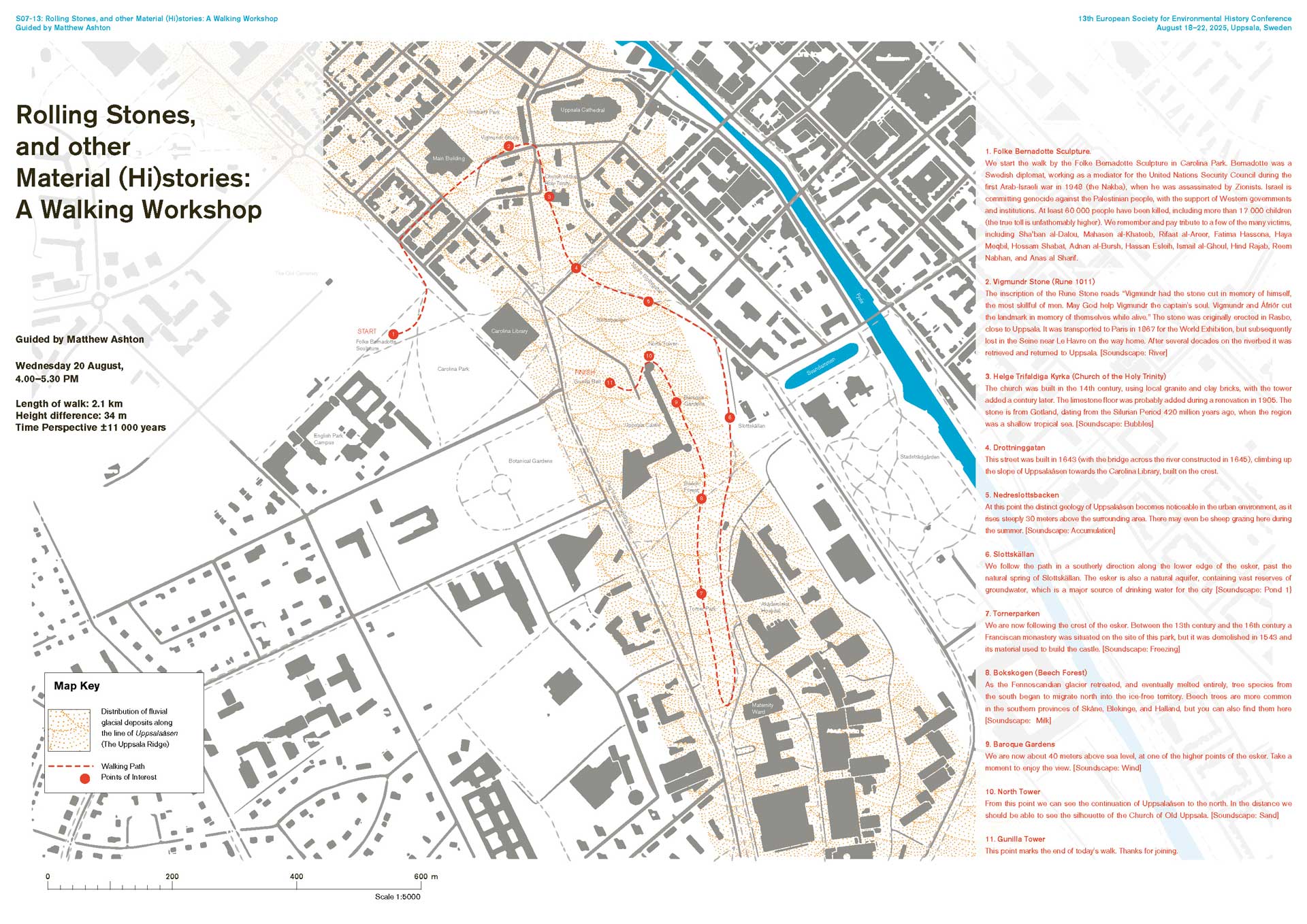
Rolling Stones, and other Material
(Hi)stories: A Walking Workshop
Walking Workshop held at the 13th European Society for Environmental
History Conference, Uppsala, 18–22 August, 2025
In her book Timefulness, geologist Marcia Bjornerud remarks that “the use of the word glacial to mean ‘imperceptibly slow’ is quickly becoming an anachronism; today, glaciers are among the rapidly changing entities in Nature.” The city of Uppsala is built upon the geological remains of a post-glacial landscape, and to a large extent built with fluvial-glacial material deposited during the later stages of the last ice-age. The most striking example of this lost frozen world can be observed in the long sandy ridge of Uppsalaåsen, which transects the city in a north-south direction. The ridge is an esker, or rullstensås in Swedish, and follows a path across the city, running from the Royal Burial Mounds of Gamla Uppsala in the north, crossing the Fyris River and rising up towards the Cathedral and the Castle, before continuing along the west bank of the river down towards Flottsund and Lake Mälaren in the south.
The esker is named after the city of Uppsala, and marks a distinctive geologic feature in the urban environment, however this section of the ridge represents only a small fraction of its total length. The esker follows a disjointed path measuring some 250 kilometres, running from the peninsula of Billudden in the north, which juts out into the Gulf of Bothnia, to the small village of Sorunda to the south of Stockholm. While the esker appears to depict the continuous meandering path of an ancient river, what it actually represents is a series of culminative snapshots of ancient flows, captured at the moment where the sub-glacial stream breached the glacier terminus, and rushed into the gestational Baltic Sea. As Swedish geologist Gerard De Geer observed, “Thus every ose-centre is nothing else than the proximal glacier-arch portion of an annual layer and, if this is to be compared to a fan, corresponds to the very handle of it…Thus the whole series of those fans are placed as tiles, one over the other…” The stop-motion composition of Uppsalaåsen becomes evident at certain points, where the esker momentarily disappears, or shifts sideways, only to re-emerge somewhere else.
This walking workshop sets out to collectively explore the hidden climate histories embedded in the urban landscape, stretching from deep time to the more recent past, speculating upon uncertain and unwritten futures. Marcia Bjornerud terms this form of spatial-temporal perception as the “habit of timefulness,” which she describes as a point of view that can offer “a clear-eyed view of our place in Time, both the past that came long before us and the future that will elapse without us.” Such a relationship with time is critical in these turbulent times if we are to avoid the catastrophic consequences of unmitigated climate change, and have any hope of turning things around for the generations still to come.
Walking as a Method
Walking is a means of learning with the environment, of gleaning knowledge and experience from interaction, observation, and experimentation with the world. It is a practice that engages the full sensory capacity of the body—sight, sound, smell and touch—in constant contact with the ground, and as such has the potential to shift the architectural gaze away from the disembodied “god’s eye view” from above towards a more partial and embedded perspective. Not that this detached view is inherently bad, but walking as a method is a way of grounding what we do in lived experience and lived space. Engaging Uppsalaåsen as a frame of reference, and story telling device, we will follow its contours, tracing a loop around the castle and its leafy surroundings, and try to immerse ourselves in times long past to rethink our present moment, hoping to initiate a collective conversation, and unearth some of the climate (hi)stories embedded in the landscape.
Walking is a part of everyday life, and as such something quite ordinary and mundane, but walking as a practice can also be employed as a particular method of research-creation. Here I build on the practice and writings of other walkers who have gone before us, and developed their own idiosyncratic walking methodologies. The Italian collective Stalker (composed of former students of architecture) set out to explore and map the in-between, abandoned urban voids of Rome in the 1990s, crafting a collective practice of walking which attempted to grasp the unconscious of the city. Lucius Burckhardt developed a pedagogical method of walking he termed “Strollology” to encourage students to closely observe urban space and life. More recently Stephanie Springgay & Sarah E. Truman of WalkingLab have explored the theory and practice of critical walking methodologies through interdisciplinary arts practices and public walking events, drawing on feminist-queer, anti-racist, anti-ableist, and anti-colonial thought to question who gets to walk where, how we walk, under whose terms, and what kind of publics we can make.
Melting Landscapes—Past, Present, and Future
The territory of Uppsala—and the whole of the Scandinavian peninsula—were formed through dramatic fluvial-glacial processes around ten thousand years ago, as a rapidly warming world melted the Fennoscandian ice sheet, which had previously covered most of the land mass in a layer of ice several kilometers thick. Today we are experiencing a similar exceptional climatic episode, as human induced climate change warms the world to unprecedented levels, threatening the collapse of vital planetary systems. We are living in a sweltering world, as temperatures constantly soar above what was once considered normal, and we are living once again in a melting world, as the worlds glaciers and ice sheets are in a precarious state of decline.
As we trace a path around, and across Uppsalaåsen—the glacially formed ridge which runs through the city—you will also be invited to listen to a series of soundscapes recorded from the rapidly melting Morteratsch Glacier in the Swiss Alps (Recorded during the summers and winters of 2015-2018). The sound recordings come from Melting Landscapes, a collective project produced by researchers and students at the Institute of Landscape Architecture at ETH Zurich, taught by Ludwig Berger, Dennis Häusler, Johannes Rebsamen, Matthias Vollmer. The sounds of ice, wind, fast moving water, and drifting stones collapse time, and recall the geological forces that shaped this landscape in the not too distant past, and remind us of the fragility of the world we inhabit.
References
Bjornerud, Marcia, Timefulness, (Princeton: Princeton University Press, 2018)
Fezer, Jesko and Martin Schmitz, eds., Lucius Burckhardt Writings: Rethinking Man-Made Environments: Politics, Landscapes & Design (New York: SpringerWienNewYork, 2012).
Ford, Laura Grace, Savage Messiah, (London: Verso, 2011)
Harvey, David, The condition of Postmodernity: An Enquiry into the origins of Cultural Change, (Oxford: Blackwell, 1989)
Hutton, Jane, Reciprocal Landscapes (New York: Routledge, 2020)
Lang, Peter, “Stalker Unbounded” in The Rise of Heterotopia: On Public Space and the Architecture of the Everyday in a Post-Civil Society, eds., Michiel Dehaene and Lieven De Cauter, (London: Routledge, 2009)Lundin, Per, ilsamhället. Ideologi, expertis och regelskapande i efterkrigstidens Sverige, (PhD diss, Royal Inst. of Technology, 2008)
Sand, Monica, En guidebok A-Ö, Gå vilse med punktlighet och precision, (Växjö: Arkitekturmuseet, 2011)
Springgay, Stephanie and Sarah E. Truman, eds., Walking MEthodologies in a More-than-Human-World: WalkingLab, (New York: Routledge, 2018)
Star, Susan L, “The Ethnography of Infrastructure”, American Behavioural Scientist 43, no. 3 (November 1999):377-91
Solint, Rebecca, Wanderlust: A history of Walking, (New York: Viking, 2000)
Tsing, Anna L., et al, Feral Atlas (Stanford University Press, 2021)