Sand, Four Acts
Published in PLAN (tidskrift för Föreningen för Samhällsplanering), Issue 1–2, Spring 2020
Act I: Formation
The most beautiful world is like a heap of rubble tossed down in confusion.
Heraclitus, Fragment 124 [1]
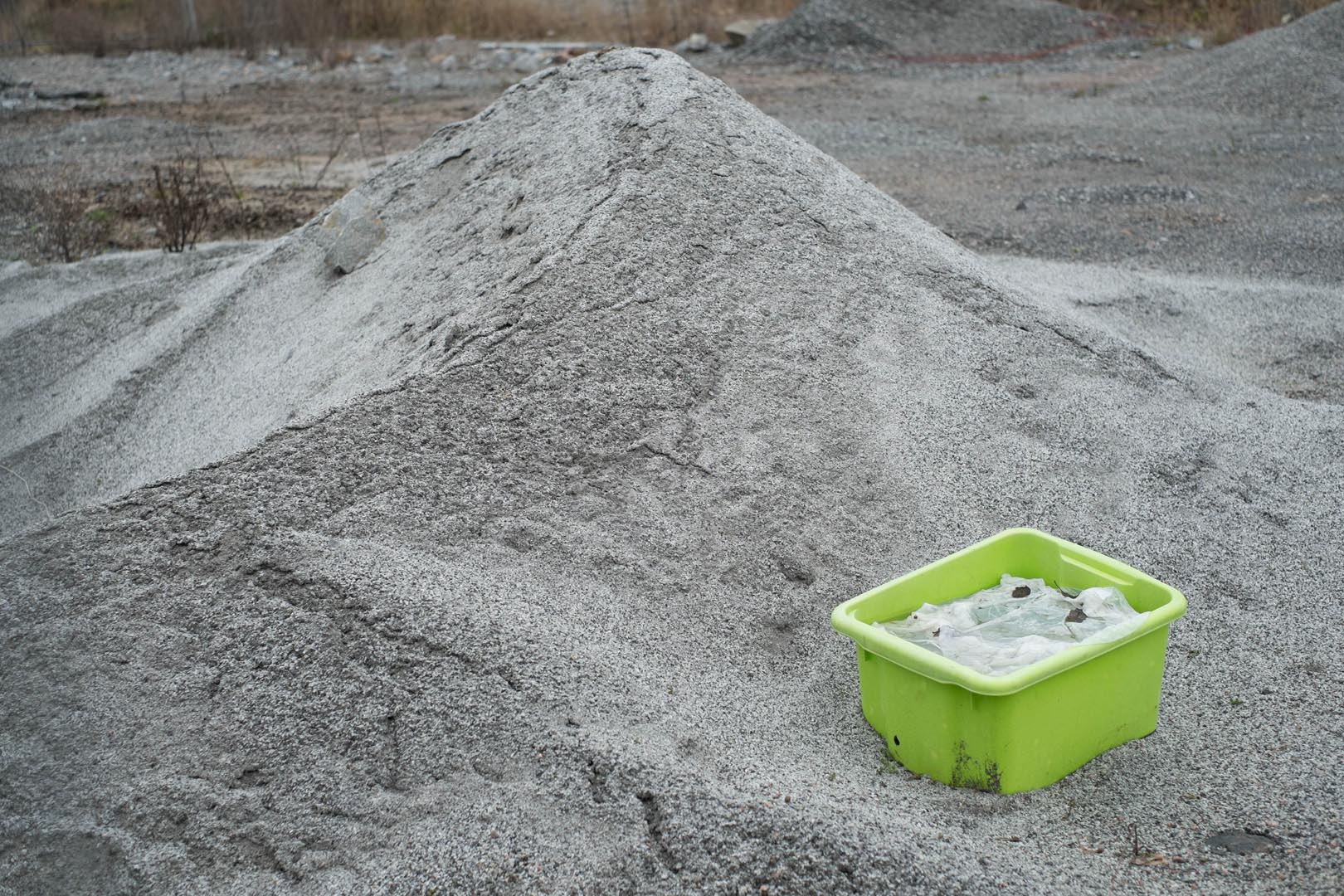
See the world in a grain of sand. Each particle is a miniature geological cosmos, tracing a path from the present moment deep into the depths of time, and beyond towards an unknown future. Sand is our entry point into the mysterious world of geology hidden below our feet—our contact with the creeping geomorphic processes constantly conditioning the earth. A material narration of slow violence and unimaginable catastrophe wrought upon the earth over millennia by the constant forces of air, water, and ice. Sand is composed of memory and time. It is mountains washed into the sea, the time it takes to cook the perfect egg, the reign of kings and queens whose glorious palaces now lie buried beneath shifting deserts, a young girls tiny footprints recorded fleetingly between waves on a perfect summer day, vacation images stored on the silicon chip of a smart phone. Sand is a reminder that the world existed long before us, and will continue to do so long after our fossilised remains have decomposed into dust.
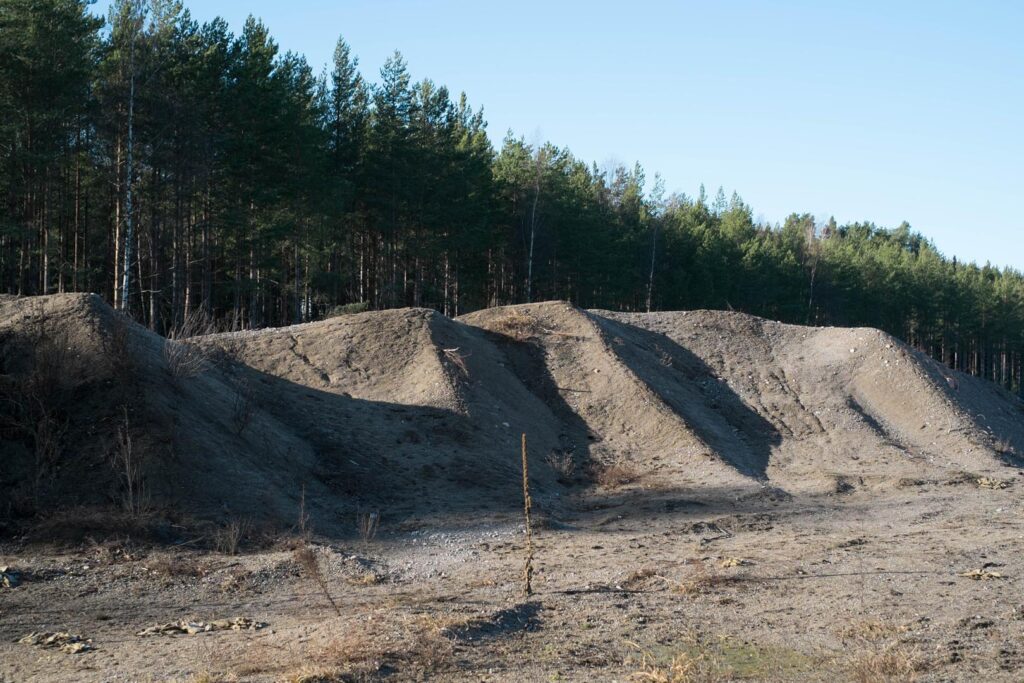
Sand, in its most basic definition, is a fine granular material consisting of rock and mineral particles. Its composition varies, depending on local geological conditions and the circumstances under which it was formed, but the most common component of sand is Silica (Silicon Dioxide usually in the form of quartz), followed by calcium carbonates—the calcified remains of corals, shellfish and other marine invertebrates deposited on the ocean floor over the last half-billion years. Sand is one of the most abundant materials found on the planet, and is a renewable natural resource, although not at a time scale comprehensible to humans—eroding mountains take time. [2] The natural terrestrial sand deposits found in Scandinavia, particularly those in central Sweden, chronicle an exceptionally violent climatic transformation which took place in the not so distant past, at least when seen from a geologic point of view.[3] Twelve thousand years ago most of what we today know as Sweden was covered by the Fenno-Scandian ice sheet, but a warming climate was rapidly altering this frozen world.[4] As ice melted on the surface of the glacier, it carved tunnels down to the bedrock, feeding a network of subglacial streams—transporting water, along with large quantities of sand, gravel and boulders—which eventually emerged at the glacier’s edge. Today the remains of these glacial watercourses are preserved in the long winding ridges of stratified sand and gravel that are scattered across the landscape, known as eskers (or rullstensås in Swedish). One of Sweden’s longest eskers, Uppsalaåsen rises gently amongst the leafy suburbs south of Stockholm, and continues in a northerly direction for 250 km before disappearing again beneath the Baltic sea. It constitutes a natural warehouse of building construction material situated conveniently on the doorstep of one of Europe’s fastest growing urban areas.[5]
Act II: Extraction
Amid the wilderness stood an engineer—not an old man, but grey from the calculation of nature. He pictured the whole world as a dead body, judging it from those parts of it that he had already converted into structures.
Andrey Platonov, The Foundation Pit [6]
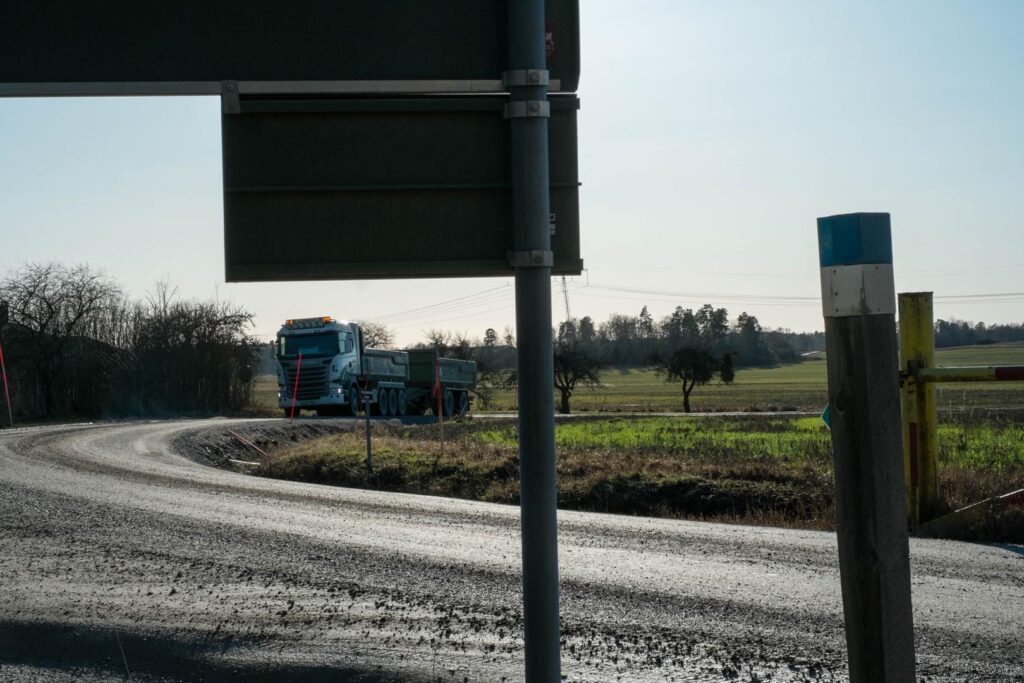
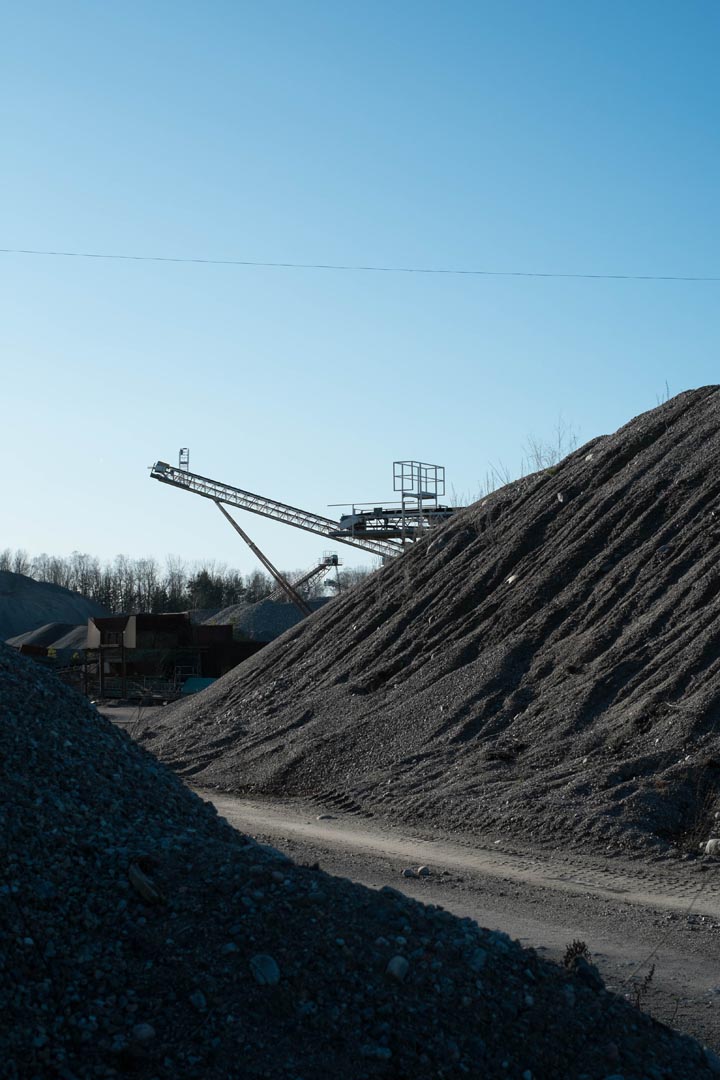
The road to Munsö is pretty. One of those idyllic Sunday drives that take you an hour outside the city, but imparts the impression that you have travelled to a different place and time. Departing the wealthy northern suburbs of Stockholm, I follow road 261 past the Versailles inspired Royal Palace of Drottningholm and its immaculately manicured pleasure gardens. I continue through fertile green and gold fields of wheat, barely and rapeseed, past parking lots, and the neat suburban plots of Ekerö. The road climbs a ridge, offering a panoramic vista over lake Mälaren, with glimpses of the brutalist southern suburbs of Stockholm in the distance. Beyond the pine forest, the road starts to narrow. The air smells of the countryside, of horses, hay, and manure. I wind down the window to fully embrace the experience, but something’s not quite right. Another reality creeps into the pastoral scene, jolting me back to the present. I pass below a canopy of high voltage cables, held in a tight grip by a platoon of metallic robot-men. The morning mist thickens around me into a sticky cloud of dust, and then I notice the trucks, passing me in convoys, each hauling a belly full of broken earth back to city.
It’s estimated that one in every four trucks on the roads of Stockholm are carrying a load of building aggregates—transferring sand, gravel, and crushed earth from one of the regions thirty-four licenced quarries (with over 1200 nationally) to construction and infrastructural projects across the expansive city.[7] Each year the capital city alone consumes around ten million tons of excavated aggerates, used primarily in the construction of roads, railways and urban, infrastructure, as well as constituting the largest component in concrete production. At a national scale, that figure rises to a staggering ninety-nine Million tons per year, or around ten tons of material per Swedish citizen, if that helps to visualise the incomprehensible scale of the entire operation.[8]
The islands of Ekerö and Munsö, ideally situated upon the rich natural sand and gravel deposits of the Uppsalaåsen, have long been industrialised and exploited for their natural resources.[9] Located within close proximity of Stockholm, as well as other cities along the shores of Lake Mälaren, the islands provide a cheap and easily accessible source of material. In the aggregates business, proximity is everything. The extremely low price of building aggregates per ton, combined with their relatively heavy weight means that transport costs begin to surpass material costs after only thirty kilometres, and to be economically viable, most quarry sites must be located within fifty kilometres of their final destination. Sand, gravel, and crushed rock are the milk and flour of the construction industry—a high volume, low cost material—fundamental to almost every construction project, from building a new detached family home, to the construction of a mega infrastructural project, such as the new Stockholm ring road.[10] The ingredients are the same, only the proportions change.
Act III: Destruction
Excavations form shapeless mounds of debris, miniature landslides of dust, mud, sand and gravel. Dump trucks spill soil into an infinity of heaps.
Robert Smithson, “A Sedimentation of the Mind” [11]
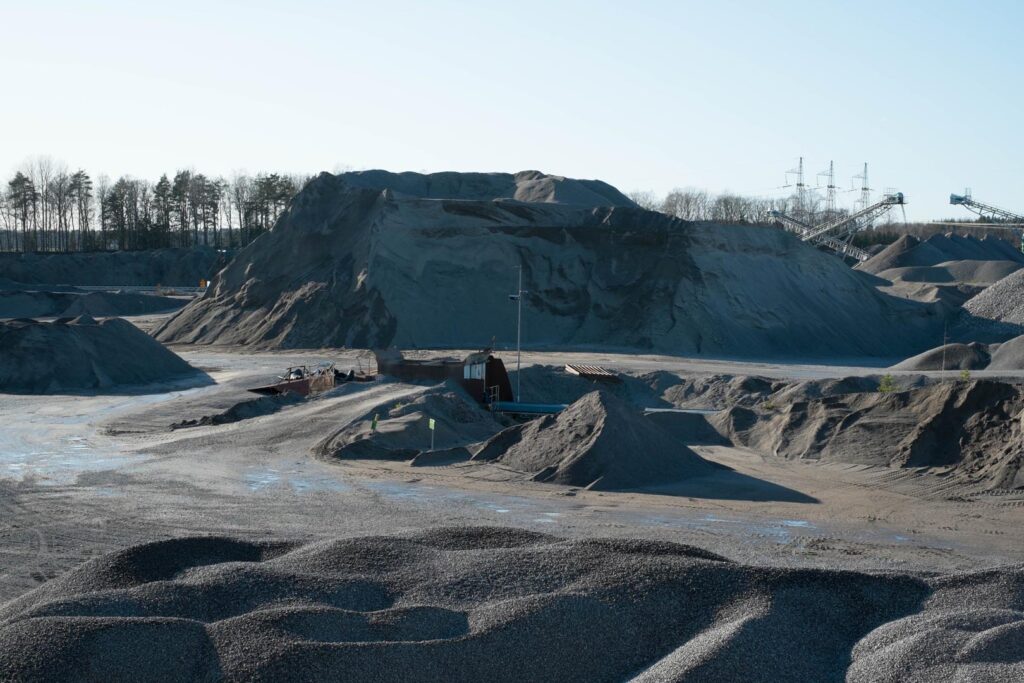
The world is running out of sand. The statement is absurd, but the truth is absolutely terrifying. If the quantity of building aggregates consumed every year in Sweden is monumental, then the total yearly global figure is truly planetary in scale. Last year alone the world consumed over fifty billion tons of sand and gravel—enough to cover the entire area of Sweden in a layer eight centimetres thick, or to visualise it another way, equivalent to eighteen kilograms per day for every human on the planet.[12] We are collectively burning through our natural sand and gravel reserves at break-neck speed, with most of it being used to produce concrete, which is a separate but interrelated global environmental catastrophe.[13] Building aggregates are the second largest resource extracted and traded by volume after water, yet in many regions sand mining operates with very little regulation or environmental controls. In several countries, such as India, Indonesia, Mexico and Morocco, sand extraction is increasingly controlled by criminal cartels, who employ bribery, corruption, extortion, and murder to circumnavigate what little environmental controls exist.[14] The effects of our insatiable appetite for sand are nothing short of catastrophic, destroying entire ecosystems and the livelihoods of millions of people who depend upon them for survival.[15]
Sand is an example of what environmental historian Jason W. Moore terms “Cheap Nature,”
Capitalism’s “law of value” was, it turns out, a law of Cheap Nature. It was “cheap” in a specific sense, deploying the capacities of capital, empire, and science to appropriate the unpaid work/energy of all global natures within reach of capitalist power.[16]
Sand is cheap because the petrocapitalist political economy demands that it cheap, like water, land, labour, and countless other necessary low value, high volume inputs that are required to keep the global economic machine running. Profits are extracted at the other end of the spectrum, in the form of speculative real estate investments, major infrastructure contracts, urban renewal projects, port expansions, roadworks, architectural services, project management fees, marketing material, airport terminals, and so on. Cheap Natures are dependant upon extractavism— upon withdrawal without replenishment, apart from the toxic residues left behind and the irreparable environmental damage wrought.[17] Sand is cheap because it is invisible, because it is everywhere. We pass by sites of extraction everyday, on the way to work, to school, on the train, on the bus. We see sand in motion, on trucks, on boats, in the scoop of an excavator, in the shoes of a child. We see sand in piles, in boxes, in bags, on the pavement, in the garden. It is in our walls, below our feet, in our roofs, in our windows, in our wine glasses, in our food, our clothes, our computers, our telephones. We live in a world of sand, we just need to open our eyes.
Act IV: Revelations
The earth is not our prisoner, our patient, our machine, or, indeed, our monster. It is our entire world. And the solution to global warming is not to fix the world, it is to fix ourselves.
Naomi Klein, This Changes Everything: Capitalism vs. the Climate [18]
Despite the science, the facts, the warnings, the expert opinions, the lived experience, the melting glaciers, the rising sea levels, the thawing permafrost, the endless droughts, the dust storms, the catastrophic fires, the coral bleachings, the disappearing insects, and the charred remains of a billion dead animals, we still seem to choose the road to oblivion over making any significant sacrifices to our current way of life. The novelist Amitav Ghosh encounters this impasse in his book The Great Derangement, reflecting “Contrary to what I might like to think, my life is not guided by reason; it is ruled rather by the inertia of habitual motion.”[19] It is this form of collective “inertia and habitual motion” that is now pushing us terrifyingly close to the precipice of abrupt and irreversible climate change, and we have very little time remaining to slow things down.
But slow things down we must. The alternative is not an option. A look at any recent graph of our global carbon dioxide emissions, although frightening, also hints at a solution, or at least clearly highlights the major flaw in our logic—every momentary decline in CO2 emissions the last hundred years correlates with a global recession.[20] The more we work, produce and expand the economy, the faster the world dies. This isn’t really a surprise, but we need to stop kidding ourselves that we can solve this mess simply with more efficiencies, sustainable solutions, and smart technology. We have been fixated with the qualitative aspects of sustainability for some time, while ignoring the quantitative aspects, and as made evident by the case of sand, quantities matter. fifty billion tons of earth a year cannot possibly be extracted without consequence. Even if that material is extracted under regulated conditions, with strict environmental laws enforced, and used to build sustainable urban neighbourhoods, public infrastructure projects, and cleaner energy alternatives, the combined carbon footprint of the entire extraction-construction process in most cases negates any environmental benefits gained, at least in the short term, and unfortunately the short term is all we have to work with right now.
As an architect, planner or engineer one must begin to ask; is an expanding construction industry really a positive outcome, and in the best interests of our planet? How can we continue to build in such circumstances, when our best intentions are so hopelessly inadequate? Building more with less is still too much for our fragile planet to handle right now—it’s time we build less, with much less.
The era of cheap nature is over.
Notes:
[1]. Fragment 124 was originally quoted by Theophrastus in Metaphysics, but this variation was quoted by Robert Smithson in “A Sedimentation the Mind: Earth Projects,” Art Forum, September 1968, republished in Robert Smithson: The Collected Writings, ed. Jack Flam (Berkeley: University of California Press, 1996), 128. Other translations of the fragment include; “The fairest universe is but a dust-heap piled up at random” (Kathleen Freeman, 1948), and “The fairest cosmos is merely a rubbish-heap poured out at random”(James Hastings, 1908).
[2]. Silicon dioxide, or silica is most commonly found in nature as quartz, which makes up over 10% of the earths crust by mass. Source: Wikipedia
[3]. For some new insights into the conception of deep time from human perspectives, a traditional story by the Gunditjmara people of south eastern Australia, recounting the formation of a mountain following a volcanic eruption is now believed to be the oldest story ever told, as geologists confirm evidence of a large volcanic eruption occurring 37 000 years ago. Colin Barras, “Is an Aboriginal tale of an ancient volcano the oldest story ever told?” Science, February 11, 2020, https://www.sciencemag.org/news/2020/02/aboriginal-tale-ancient-volcano-oldest-story-ever-told
[4]. Similar to what is occurring to the worlds glaciers and ice sheets today as a consequence of global warming, especially in places like Greenland and Antarctica. Fiona Harvey, “Greenland’s ice sheet melting seven times faster than in 1990s,” The Guardian, December 10, 2019, https://www.theguardian.com/environment/2019/dec/10/greenland-ice-sheet-melting-seven-times-faster-than-in-1990s
[5]. Stockholm is consistently ranked as one of Europe’s fastest growing cities. See for example, Mia Tottmar, “Unga driver utvecklingen i attraktivt Stockholm,” Dagens Nyheter, July 3, 2019, https://www.dn.se/sthlm/unga-driver-utvecklingen-i-attraktivt-stockholm/
[6]. Andrey Platonov, The Foundation Pit (London: Vintage, 2010), 12.
[7]. Lars Norlin and Mattias Göransson, Grus, sand och krossberg 2018, (2019:3).Uppsala: Sveriges Geologiska Undersökning, 2019, http://resource.sgu.se/produkter/pp/pp2019-3-rapport.pdf
[8]. Norlin and Göransson, Grus, sand och krossberg, 15.
[9]. Jan Malmsted, “Från bondgrop till storindustri: teknik- och industrihistoria på Mälaröarna” in Dædalus:Tekniska Museets Årsbok Årgång 73(2005), (Stockholm. 2015), 47–63.
[10]. For information about the massive quantities of material needed to construct Stockholm’s new ring road, see; Niklasson Bengt and Johan Brantmark, Masshanteringsplan E4 Förbifart Stockholm (E4FS 2015:0064). Stockholm: Trafikverket, 2015.
[11]. Robert Smithson, “A Sedimentation of the Mind: Earth Projects”, First published in Artforum, September 1968 in Robert Smithson: The Collected Writings edited by Jack Flam (Berkley:University of California Press, 1996), 101.
[12]. United Nations Environment Progamme (UNEP), Sand and sustainability: Finding new solutions for environmental governance of global sand resources. GRID, Geneva: Switzerland, United Nations Environment Programme, 2019, https://unepgrid.ch/storage/app/media/documents/Sand_and_sustainability_UNEP_2019.pdf
[13]. Jonathan Watts, “Concrete, the most Destructive Material on Earth,” The Guardian, February 25, 2019, https://www.theguardian.com/cities/2019/feb/25/concrete-the-most-destructive-material-on-earth
[14]. Vince Beiser, “The Deadly War for Sand,” Wired, March 26, 2015, https://www.wired.com/2015/03/illegal-sand-mining/
[15]. See the film, Sand Wars, directed by Denis Delestrac (ARTE France, 2013)
[16]. Jason W. Moore, “The Rise of Cheap Nature” in Anthropocene or Capitalocene?, Edited Jason W. Moore (PM Press: Oakland. 2016), 82.
[17]. For further reading on “Extractavism” see Sandro Mezzadra and Brett Neilson, “On the Multiple Frontiers of Extraction: Excavating Contemporary Capitalism,” Cultural Studies, vol. 31, issue 2-3 (2017).
[18]. Naomi Klein, This Changes Everything: Capitalism vs. the Climate (New York: Simon & Schuster, 2014), 279.
[19]. Amitov Ghosh, The Great Derangement: Climate Change and the Unthinkable (Chicago: University of Chicago Press, 2016). 54
[20]. Global emissions data: https://ourworldindata.org/co2-and-other-greenhouse-gas-emissions