
Art in Concrete and the Swedish Building Industry
Co-authored with Erik Stenberg. In Architecture and Welfare: Scandinavian Perspectives,
eds., Thordis Arrhenius, Guttorm Ruud, Ellen Braae. Birkhäuser, 2024.
In Scandinavia, the concrete neighborhoods constructed during the 1960s and 1970s are often framed—in a revisionist manner—as a historical anomaly: a material and urban artefact that sits uncomfortably with the perceived image that the Nordics have of themselves and wish to project outwards, as smart, cosmopolitan, and environmentally conscious. Large-scale prefabricated housing estates are viewed as something that must be remedied, at the extreme through demolition, but otherwise through different forms of integration, transformation, discipline, and intervention. This is a trend clearly observable in Denmark and Sweden, where many such neighborhoods are listed on official lists as “ghettos” or “vulnerable areas” and slated for different forms of redevelopment, often reconfigured according to more traditional urban ideals, under the thin guise of “sustainability.”[1] It could be argued that today we are observing the slow dismantling of the welfare state, empowered through alternative narratives transmitted through the medium of concrete. While current political, economic, and cultural forces seem more intent on tearing things apart, previous constellations were more interested in building something new.
Concrete, as a material, played a pivotal role in materializing the Nordic model of welfare, giving it an architectural form and aesthetic sensibility, embodying the ideals of democracy and equality. It’s historic rise to dominance during the welfare-state era, however, was no mere coincidence, but emerged through the particular social-economic circumstances of the period, cultivated by an alignment of shared interests. Through concrete, the economic dream of rationalized construction processes intersected the artistic desire for aesthetic experimentation. As Norwegian artist Carl Nesjar proclaimed, “concrete is the natural meeting point for the architect and the artist.”[2]
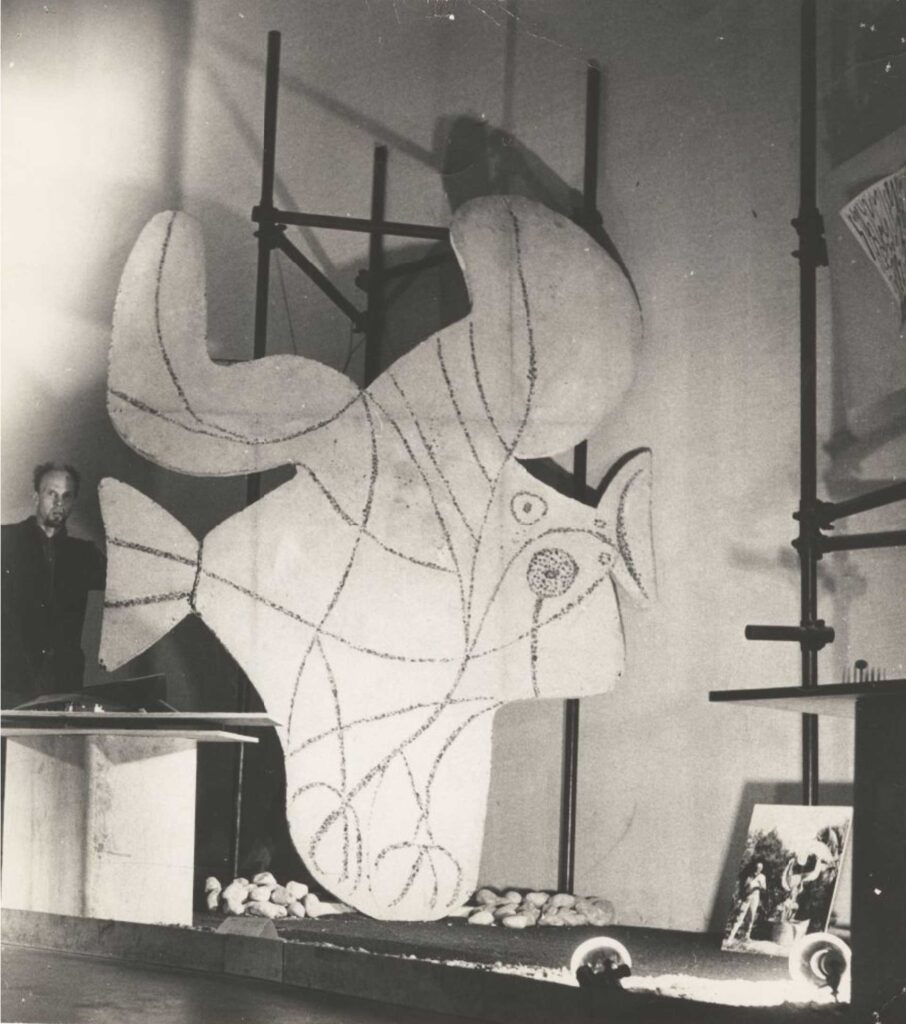
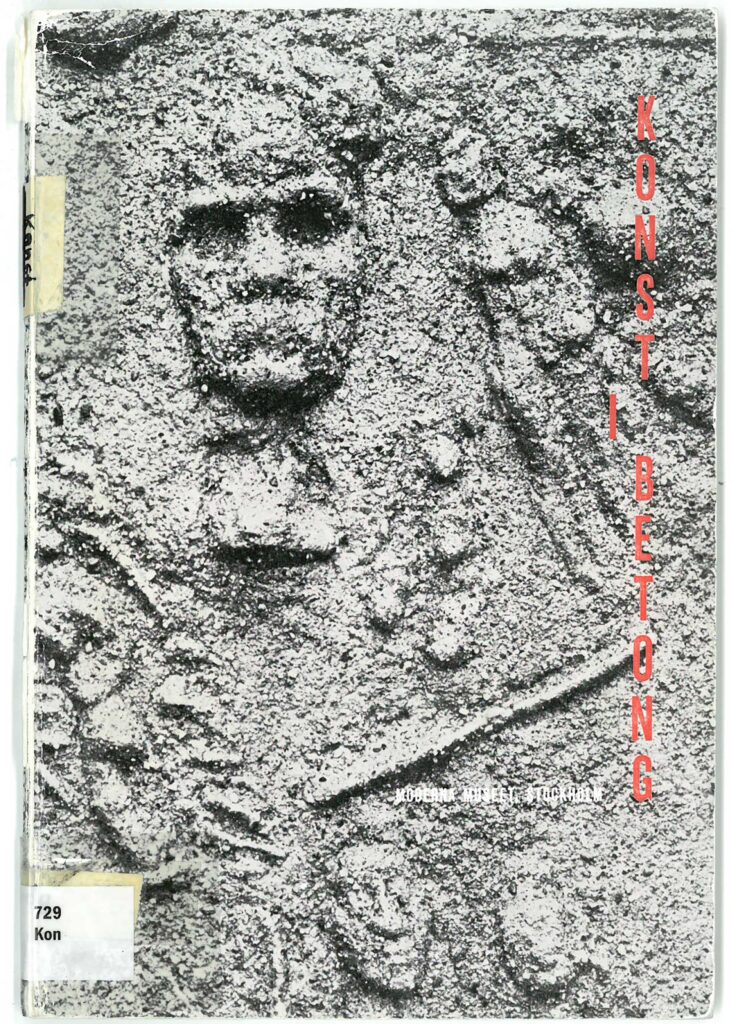
On May 23, 1964, the exhibition Konst i betong (Art in concrete)opened at Moderna Museet (the museum of modern art) in Stockholm, offering the public a chance to see a selection of artworks by contemporary artists working experimentally with the material of concrete. Pablo Picasso’s sculpture Fågelfisken was a major drawcard, sandblasted in concrete by Carl Nesjar [Image 1]. Works by Nordic artists such as Siri Derkert, Lars Englund, Einer Höste, Erik Hesselberg, Inger Sitter, as well as individual work by Nesjar, were also on display.[3] The exhibition was a collaboration between the museum and Svenska Väg- och Vattenbyggares Riksförbund (SVR, the Swedish Association of Road and Water Builders),with curatorial credit given equally to the museum’s director, Pontus Hultén, and Olle Rinman, the chairman of SVR. Situated on an island in central Stockholm, surrounded by the waters of the Baltic Sea, the museum offered an avant-garde setting for SVR to celebrate their twenty-year jubilee.[4] Some of the biggest names in the Swedish construction industry at the time sponsored the event, including the two largest cement producers, Cementa and Gullhögen, as well as public housing organizations such as Svenska Bostäder and Hyreshus i Stockholm, and half a dozen private builders, including John Mattson, Olle Engkvist, and Ohlsson & Skarne.
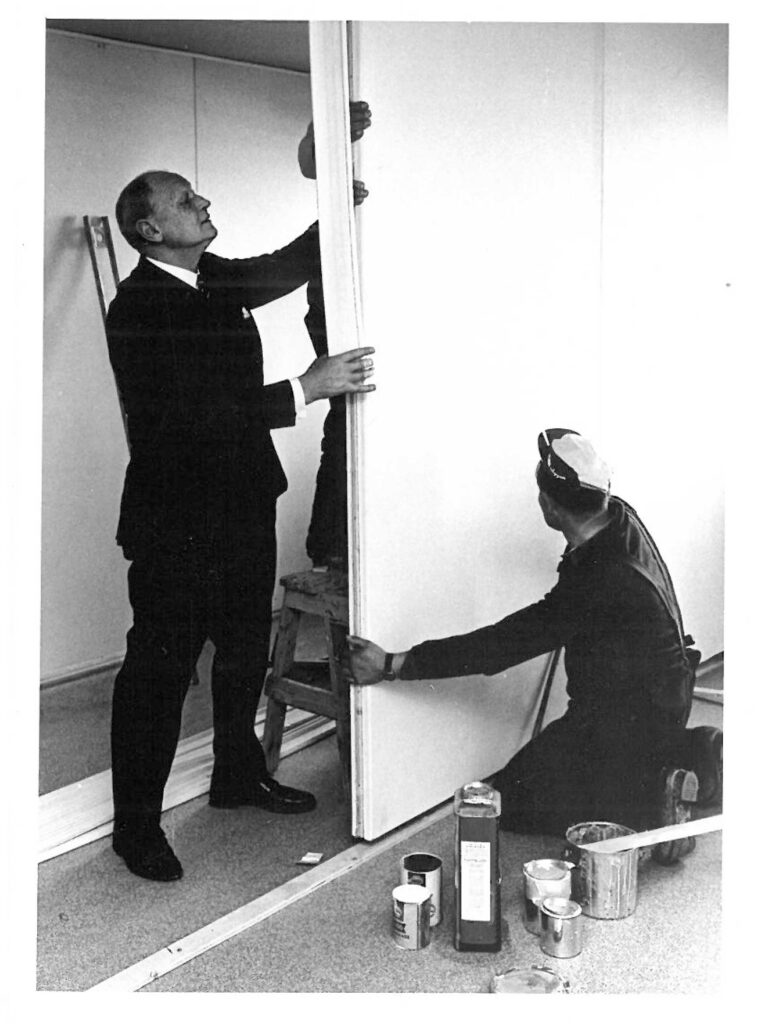
The exhibition opening was a gathering that would bring together artists, curators, engineers, architects, planners, builders, landlords, material suppliers, and politicians, staging a broad discussion about concrete as a material, and its place within the future of the Swedish welfare state. In attendance was a powerful yet diverse group of actors with substantial cultural, political, and economic muscle, who could exert substantial influence over governmental policy directions. The opening party was followed by a four-day conference, with Allan Skarne, owner and director of Ohlsson & Skarne, invited as a distinguished keynote speaker.[5] Skarne (1909-1998) was a second-generation builder deeply involved in the shift from a craft-based to an industrialized construction sector in Sweden and abroad; starting in 1963, licensees of the Skarne System were located in six European countries, as well as the Middle East.[6] [image 2] He also shared a close personal relationship with the museum’s director Pontus Hultén, who was married to his niece, Anna-Lena Wibom. Skarne was a keen collector of modern art, amassing an enviable collection at his private island residence in Stockholm, and upon the occasional request from Hultén, provided financial support to the budding museum, including the purchase of the large-scale Alexander Calder sculpture The Four Elements in 1961, which he gifted to the Museum’s permanent collection in 1967.
Skarne was an advocate of the need for rationalization and technological innovation in the construction industry, but he was also a strong supporter of art and architecture. He firmly believed that further mechanization of building processes would give greater freedom to artists and architects, arguing that:
It is clear that the rationalization of construction requires rational planning, but this should give architects more time to devote themselves to greater undertakings—to shape our interior and exterior residential environments and to give the hard-pressed modern working citizens an environment of leisure that provides both peace and stimulation.[7]
The exhibition Konst i betong aimed to highlight the artistic and aesthetic possibilities of concrete. By building using rational construction techniques and processes, in close collaboration with architects and artists, a new architectural aesthetic was to be produced that was representative of the ideals of the welfare state. This point of view was emphasized at the exhibition conference, where Skarne, together with architect Johannes Olivegren and artist Bertil Gottsén partook in a discussion concerning art in construction, with a particular focus on the 1% rule—a principle applied in Sweden, Denmark, and Norway, which stipulates that 1% of a buildings’ construction costs should be spent on commissioning artistic work for the project.[8]
Between June 7 and 13, 1964, Socialdemokraterna (the Swedish Social Democratic Party) held their twenty-second congress at the recently built Folkets Hus(People’s House), a civic center designed by the celebrated Swedish modernist architect Sven Markelius. On TuesdayJune 9, the party held a heated debate on housing and land policy—a critical issue at the time, as the country was still suffering from a substantial housing deficit, combined with rising construction costs and acute labor shortages. The debate was led by Minister of the Interior, Rune Johansson, and addressed the many factors hindering the production of new housing, such as the difficulty that builders had had in securing financing, and the obstructions faced by municipalities in attempting to purchase land for development. Johansson emphasized the necessity for municipalities to engage in long-term urban planning to ensure that builders received plots in good time and highlighted the need to pursue “rational” construction processes.[9] The debate ended with party members voting to establish a working group that would put together a report on the housing situation and present proposed solutions. The resulting government white paper Höjd Bostadstandard (Raised housing standards) laid the foundations for the housing policy of the Million Homes program, an ambitious government-led plan to construct one million new dwellings within a ten-year period across Sweden (1965-1974).[10]
The housing shortage combined with rising building costs was a thorny political issue for the government at the time, emphasized by Finance Minister Gunner Sträng at a public debate organized by SVR in the spring of 1964, arguing “one must invest in standardization. Everything to keep price increases at bay.”[11] Present at the same debate, and representing the interests of private builders, was Alan Skarne, who presented his view that: “The construction industry should learn from the shipbuilders and the auto industry … both single family houses and rental apartments ‘in packages’ should and could be delivered, similar to Volvo’s car packages. A few models that have the essentials in common.”[12] It was the emphasis on “rationality” in both construction processes and urban planning principles that paved the way for concrete to emerge as the preeminent material from which the Million Homes Programwould be constructed, and perpetually reinforce its association with the architecture of the welfare state. Concrete was cheap, plentiful, durable, and above all, suited to industrial production methods; this combination made it especially attractive as a political solution to the housing deficit, which would not put too much inflationary pressure on the economy.
State of the Art in Concrete
As a material, concrete is plastic, malleable, shapeable; it is capable of expressing a diversity of colors, textures, finishes, surfaces, and, thus, atmospheres. While industrialists and politicians were praising the technological and economic potential of the material, the exhibition Konst i betong put its aesthetic qualities on display, demonstrating a multitude of ways combinations of sand, water, stone, and cement could be crafted competently by artists and architects. The future city of concrete would be rational, but also beautiful, sensuous, and demonstrative of human creativity. 1964 can be seen as a watershed year for concrete in Sweden, when political, economic, and cultural forces momentarily converged, setting the conditions for the unprecedented large-scale era of construction that was to follow. The rise of concrete did not, as such, emerge out of a vacuum, just as its eventual dominance within the Swedish construction industry was neither inevitable nor guaranteed. Sweden had strong domestic timber and steel industries, equally capable of producing rational housing solutions on a large scale, yet it was concrete that took the early initiative, a development in no small part due to technological innovations in prefabricated concrete panel construction developed by a pioneering group of builders, in which Ohlsson and Skarne playing a decisive role.
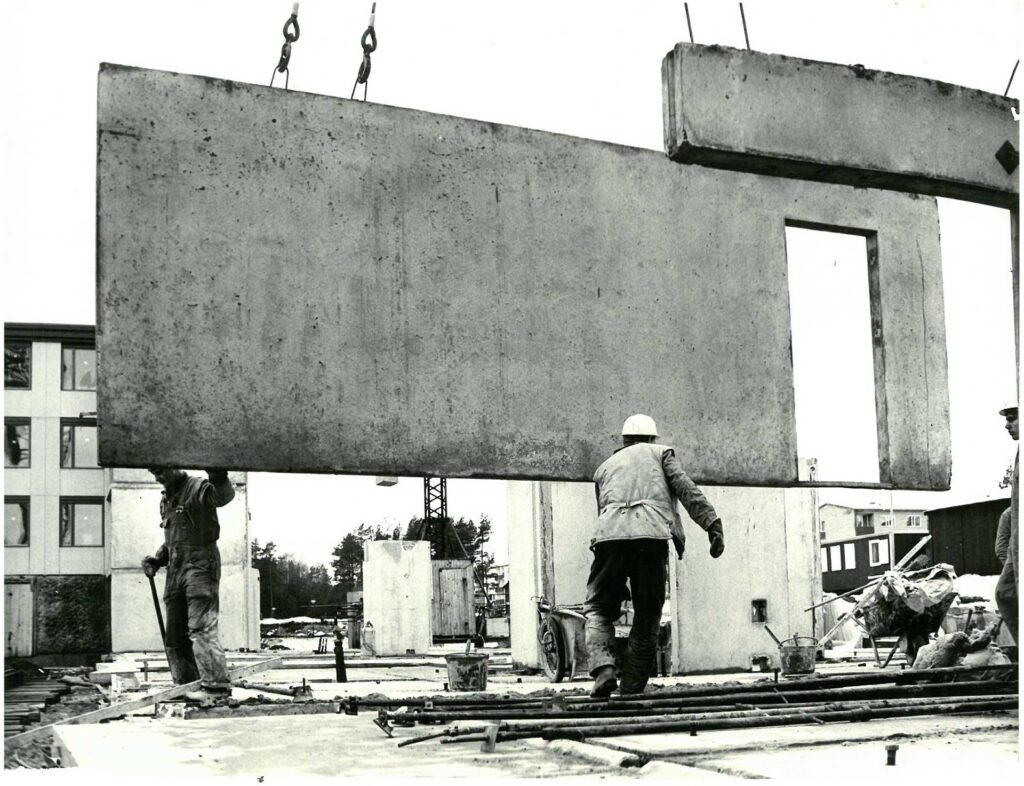
One of the main factors driving an increased interest in prefabricated concrete construction methods in the early 1960s were acute labor shortages, and the sky-rocketing building costs that followed. Real economic growth was achieved through the export-orientated manufacturing industry, not the local construction industry, so with a limited supply of workers it was preferable to automate building processes as much as possible to increase the supply of labor available to manufacturers. Once the prefabrication technology had been implemented in residential construction, the following step was to develop integrated building systems where the elements were part of an interconnected chain from design and project planning to factory production and implementation.[13] Rationalized construction methods dramatically improved productivity—in 1950, it took approximately eight hours of work to complete a cubic metre of housing with traditional craft-based construction, while by the start of the 1970s the same amount of work could be completed in two and a half hours.
The construction firm Ohlsson & Skarne were pioneers of prefabricated concrete building systems, optimizing and rationalizing construction processes, and implementing and developing technical innovations within the construction industry. [image 3] In 1963, they were ranked the seventh largest producer of concrete construction elements in Sweden, with production spread across four factories.[14] Allan Skarne had a long interest in transforming and modernizing the Swedish construction industry, often using his own building firm to experiment with new technological innovations, explore more efficient, cost-effective construction methods and streamline organizational structures. Concrete was at the core of Skarne’s construction business—it was the material which could dramatically revolutionize the Swedish construction industry, through rationalization, standardization, and prefabrication. By the mid-1960s, early prefabrication methods and prototypes had now also shifted to building systems, with the prefabricated concrete elements provided in “packages” of project planning, production, and delivery of whole precast structures comprising of floor slab elements and interior and exterior load-bearing wall units. By 1967, these building systems were being used to produce more than 8,000 flats in Sweden, with a capacity estimated to increase to 30,000 flats by 1970.[15]
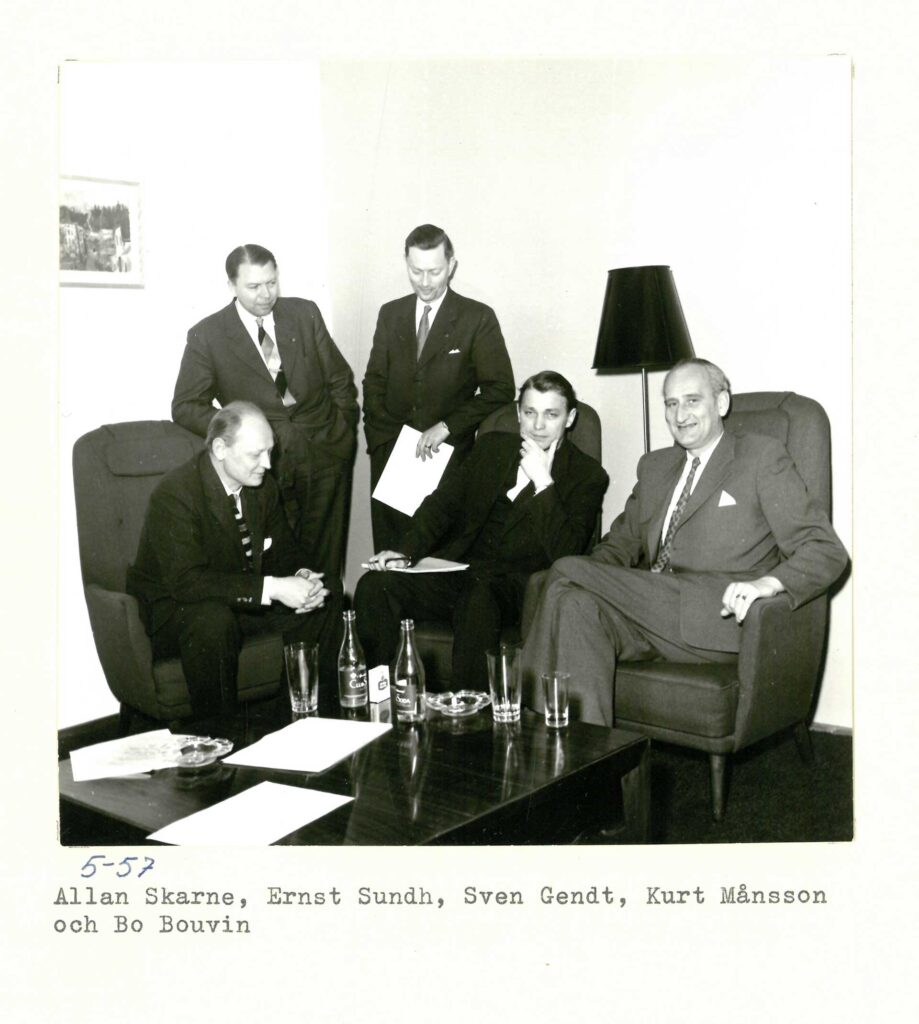
In 1955 Allan Skarne was influential in establishing a network of like-minded individuals interested in developing, improving, and sharing knowledge about prefabricated concrete panel construction. The group, known as “D4 Gruppen” (the D4 Group), consisted of builders Allan Skarne, Ernst Sundh, Sven Gendt, and Bo Bouvin, with Kurt Månsson serving as secretary. [image 4] All had senior roles in companies and organizations pursuing technical innovation and rationalization within the construction industry. Over the course of forty documented meetings, everything from safety at work during prefabrication to pricing for assembly work was discussed, and in 1960 they even founded the company Sprutteknik AB together to circumvent the painting trade union and built 42 houses in Jakobsberg.[16] D4 Gruppen formed a hub for element-based construction, primarily through collection and dissemination of know-how, as well as the development of new financial and technological models. The members were in touch with all parallel developments in industrial construction in Sweden—architects, government initiatives and investigations, as well as with other element builders. The group and its members thus played a critical role in innovating, expanding, and disseminating knowledge about prefabricated concrete panel construction methods in the period directly preceding the Million Homes Program, and set the conditions for the unprecedented large-scale housing construction necessary for its implementation.
Allan Skarne describes the role of the builder changing in the early 1950s in line with the shift from craft to industry, foreseeing the potential of both increasing the quantity and quality of housing built using prefabricated building elements.[17] The Östberga project, built between 1950 and 1954, in collaboration with architect Lars-Magnus Giertz and Sven Wallander of HSB, became a fundamental testing ground for implementing new construction methods and techniques, such as flexible floor plans, battery casting of elements, a heat-exchange ventilation system, and attempts to reduce labor costs through total pre-fabrication. These early experiments in the on-site casting of room-sized elements faced several challenges. The measurements and tolerances of the elements were not sufficiently precise to be repeated in larger quantities, and working unprotected during the harsh Swedish winter months made it even harder to ensure that consistent quality was maintained. As a response to these shortcomings, temporary field factories that could produce, store, and deliver elements to the site in greater quantities were built on-site specifically for larger developments. The Bollmora project, built by Ohlsson & Skarne between 1959 and 1961, a field factory was set up with a capacity to produce precast elements for up to 500 units per year. The project also utilized a French Pingon tower crane with a lifting capacity of 16 tons to construct almost 1,000 units in 12 blocks, at 6–8 storeys each.[18] In less than fifteen years the technology and capacity needed to shift the Swedish housing sector into a large-scale adaption of prefabrication had thus been established.
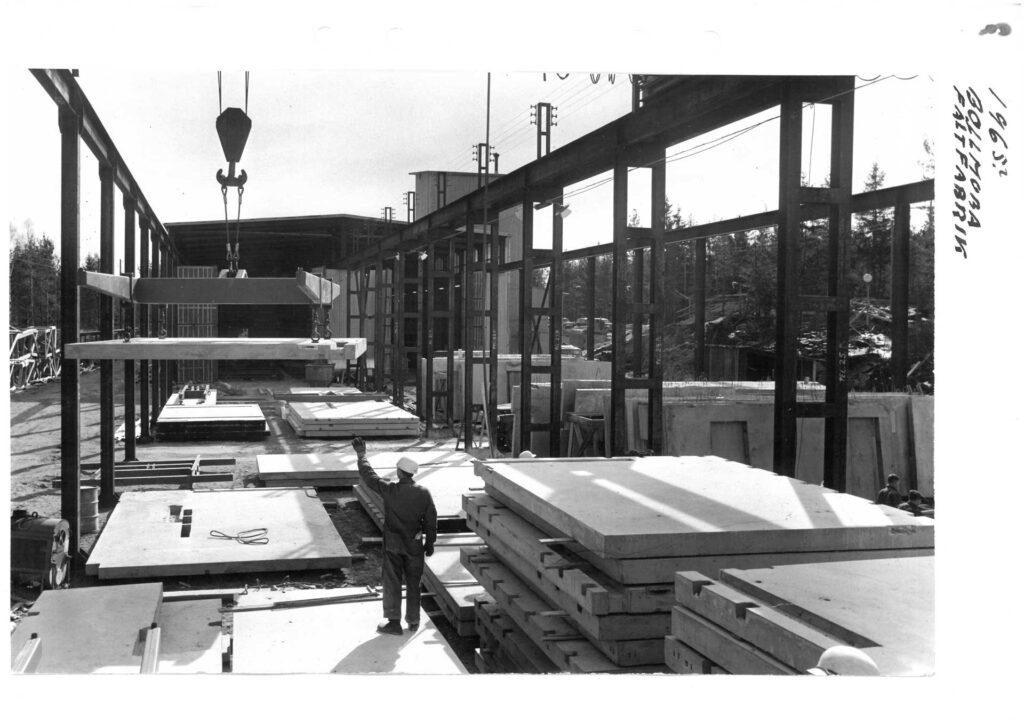
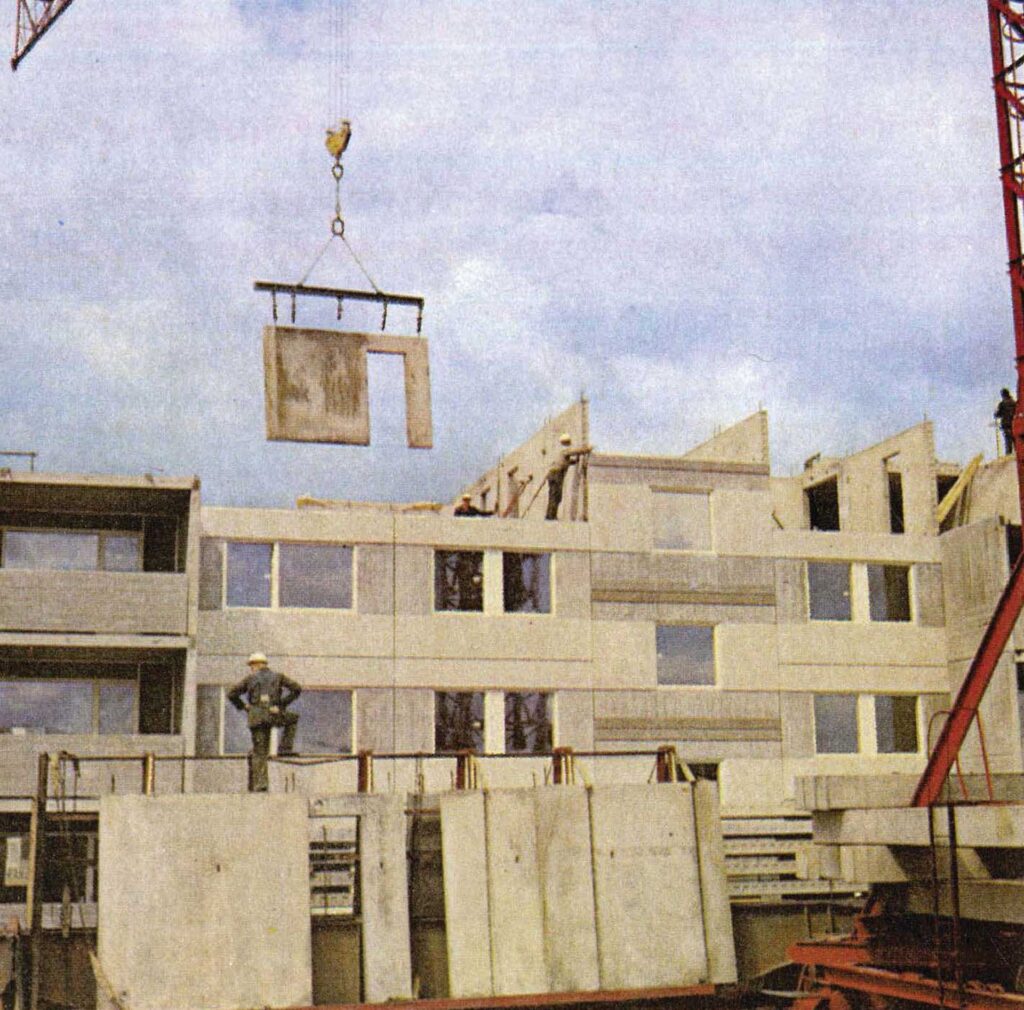
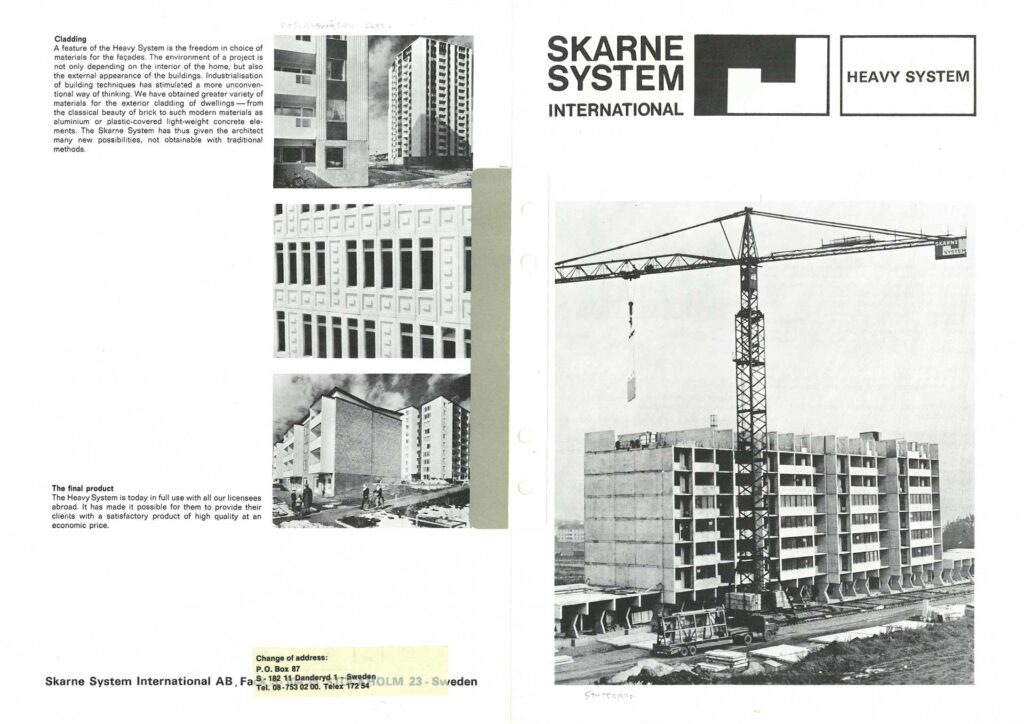
Throughout the 1950s and 1960s, Ohlsson & Skarne developed three prefabricated concrete panel systems: the Lightweight System, the Heavyweight System, and System S66. The Lightweight System was developed following Ernst Sundh’s method of building with room-sized elements mounted on a gantry crane, and first implemented by Ohlsson & Skarne in Stabby Gärde in Uppsala, which was built between 1952 and 1953. The Heavyweight System, which was developed specifically for the Östberga project in Stockholm, used fewer yet larger concrete elements with a maximum weight of up to twelve tonnes, and could be assembled using a small number of large cranes. [image 5] Kv. Diset in Uppsala, which was built in just twenty-eight days in the spring of 1966, became the prototype building for what came to be known as System S66. This system is perhaps the most advanced industrialized element system made of concrete ever built, combining a very high degree of spatial flexibility with prefabricated concrete panel construction. System S66 used slab structures that rested on load-bearing external and apartment-separating walls, with a centrally positioned column ensuring that the slab sizes were manageable, rendering the remaining interior walls flexible or movable. This allowed residents to easily reconfigure the spatial layout of their homes to cater for their diverse and changing needs, or as a brochure for the system writes, “System Skarne 66will instead give house consumers the utmost freedom to shape their own dwelling—and more than that, their home.”[19]
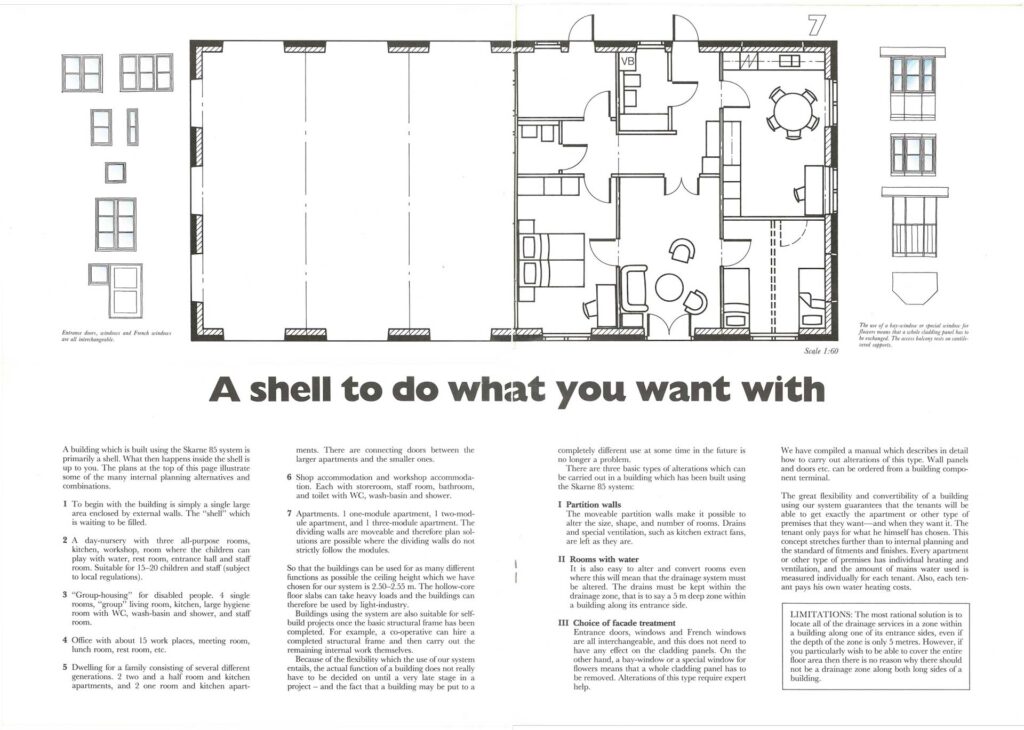
The final concrete panel system developed by Allan Skarne was System S85 (the Convertible Building), which was produced in the mid-1980s in collaboration with Lennart Adolfsson and Curt Hunhammer, with support from Skanska and the Swedish National Council for Building Research.[20] [image 6] Like the preceding System S66, System S85 was also designed to maximize “flexibility” for residents and “convertibility” over time, with the possibility of joining smaller and larger apartments together to create multi-generational homes, as well as the foresight to adapt apartments to other activities and functions—such as an office, school, or kindergarten—if need be.[21] The major point of difference between System S66 and System S85 was that the latter was conceived following the Million Homes Program, in an era where the ideals of the welfare state were radically shifting. As Skarne himself describes it, “The name ‘System S85’ has a technical sound, but it actually concerns buildings that have a strong association with the historic Swedish small town—a dense, uniform but richly varied urban form that creates the framework for the city’s inhabitants and activities.”[22] The system was never an economic success in Sweden, nor as widely implemented as previous systems, yet it presents a fascinating example of an innovative attempt to adapt standardized prefabricated panel systems to the changing aesthetic, social, economic, and political realities of the time.
On the precipice of the Million Homes Program, Allan Skarne, alongside other members of D4 Gruppen, could effectively demonstrate the merits of concrete as a rational, cost-effective, and robust building material. A material particularly well-suited to industrial production processes and the demands required of such a large, and unprecedented housing policy. Acquiring essential knowledge on rationalized production processes and effective organizational structures from the likes of the carmakers Volvo, the shipbuilders Kockum, and the electrical manufacturers ASEA, Ohlsson & Skarne developed what promised to be the most rational concrete panel system yet, System S66. The building system for multi-story residential construction was to accommodate the entire building process—from land acquisition and planning through to the finished residential neighborhood—as well as covering building operation, management, maintenance, and eventual renovation requirements.[23] System S66 had ambitions to become, in essence, the standard Volvo model of the construction industry—a building system that could easily be implemented on a large scale throughout Sweden, and even beyond. In 1967, Skarne sold Ohlsson & Skarne to Skånska Cementgjuteriet (today known as Skanska), transferring the company’s rich knowledge and experience in prefabricated concrete panel construction to the dominant construction firm in the Nordic region. While Ohlsson & Skarne were certainly trailblazers, the other major construction firms soon followed, and knowhow about prefabricated concrete construction rapidly spread throughout the industry and is still the prevailing technology in contemporary housing construction.
Art in Concrete
While the technological innovations in concrete construction methods appealed most to builders and politicians, aesthetic considerations were equally significant. As a construction material, concrete was nothing new in the Nordic countries and had been readily used for decades, yet it was normally concealed in the load-bearing structure, hidden behind a façade of stucco or masonry. The shift to prefabricated panel construction integrated the façade and the load-bearing structure at the factory, reducing the need for expensive onsite scaffolding and labor to add surface cladding, which would have increased building costs and undermined the rational logic behind the construction technique. Thus, in order to gain widespread acceptance of prefabricated concrete construction, it was necessary to elevate the status of the material—to present it not only as something modern and rational, but also elegant, respectable, and cool. It was important to make it socially acceptable, even desirable, to live in a modern concrete home. The Konst i betong exhibition at the Museum of Modern Art in Stockholm could be viewed as one such effort to shift perceptions on concrete — among both building professionals and the general public — and present it as the material that would unite structural efficiency with artistic expression. As Carl Nejsar writes in the catalogue accompanying the exhibition,
Concrete is the most important building material of our time. It has broken the hegemony of stone and wood. But this does not mean that we have yet fully mastered concrete, or that we have consistently let its special properties have free play in the design of our architecture, or that we have fully utilized its possibilities constructively and aesthetically.[24]
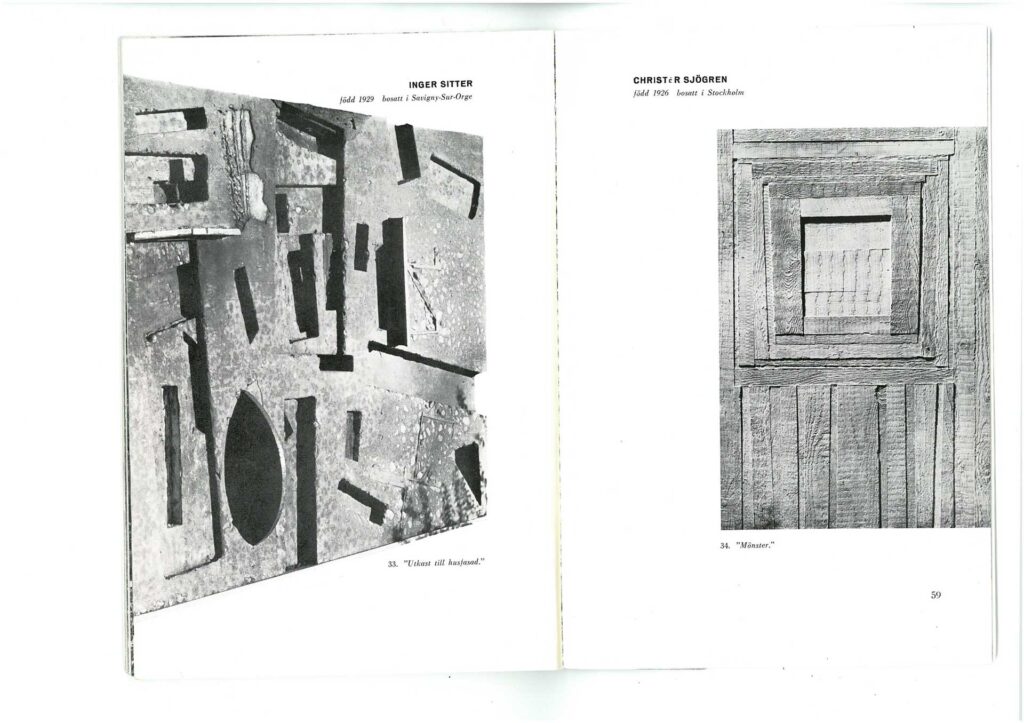
Concrete offered the possibility of a new synthesis between art and architecture, where artistic ornamentation of buildings would not come as an afterthought, but would instead be integrated into the architectural design from the beginning, or as Nesjar writes “that the art both conceptually and materially is part of the architecture.”[25] This view was reiterated by the exhibition’s curators, Hultén and Rinman, writing in the introduction, “traditionally, artists have beautified our communities and neighborhoods afterwards—when the architects and builders have done their part. Concrete has given them opportunities to participate in creation from the beginning.”[26] The exhibition displayed a selection of large-scale concrete sculptures and reliefs, many of which were based on public art commissions carried out in new subway stations, housing estates, and public spaces. A series of photographs were also exhibited, illustrating creative collaborations between artists and architects, including Carl Nesjar and Inger Sitter’s work with Erling Viksjø on the new government quarter in Oslo, as well as Odd Tandberg and Bengt Olson’s contributions to new courthouses in Borås and Kristinehamn, respectively [Image 7-8].[27]
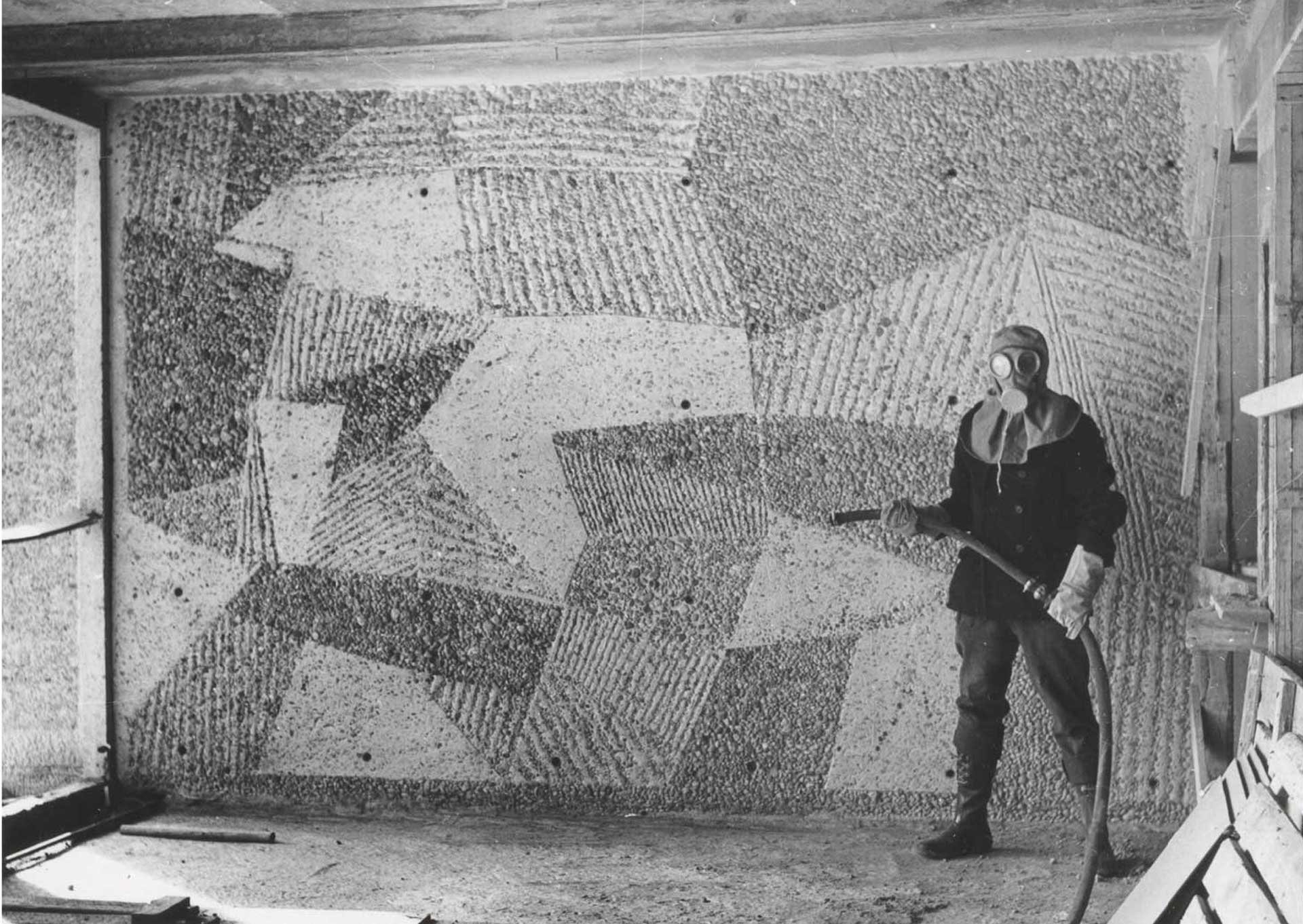
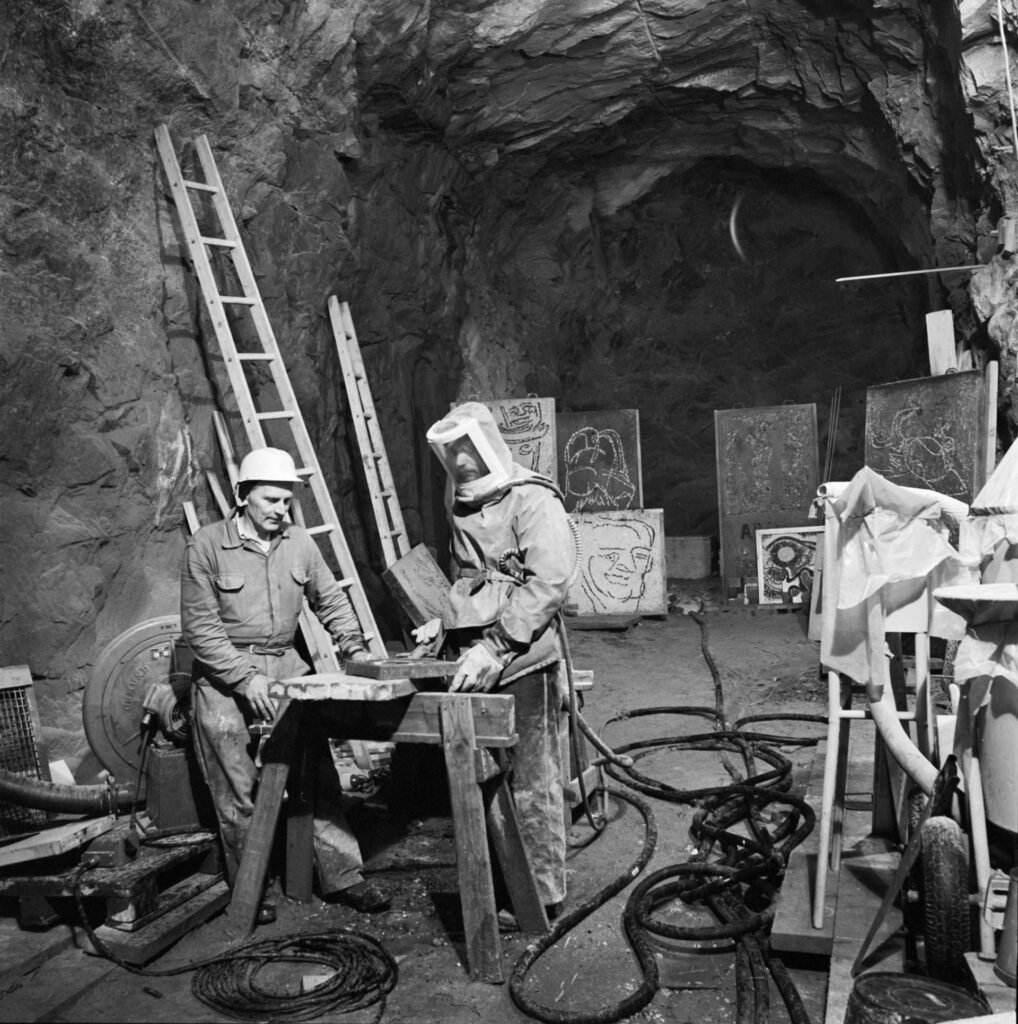
Carl Nesjar was undoubtedly a central figure behind the exhibition, as one of the leading Nordic artists working with concrete at the time. He had become one of the preeminent experts in the technique of sandblasting concrete—a method of engraving a concrete surface by exposing it to a flow of sand pumped under immense pressure, which he likened to painting with a firehose.[28] He perfected this technique through years of close collaboration with the Norwegian architect Erling Viksjø on the government quarter in Oslo, which was constructed entirely of naturbetong (natural concrete) [Image 9]. Naturbetong is a particular concrete process and technique developed through experimentation by Viksjø, and later perfected, and patented, with the help of the civil engineer Sverre Jystad.[29] The process involved first tightly packing a formwork with clean, washed aggregates of a similar grade, before injecting a fine liquid cement mixture, which filled in the voids between the stones. Before the concrete hardened completely, the formwork was removed and the surface sandblasted, revealing an even layer of tightly packed stones. [30] Naturbetong accentuated the intrinsic aesthetic qualities of the material itself, transforming the composite character of concrete into a creative palette that offered endless opportunities for artists and architects. As Erling Viksjø reflected, “concrete is in the process of finding its own architectural and constructive language, and we can no longer accept cladding with stone or clay. The concrete—the building material itself—must have its own expression of architectural value.”[31] Naturbetong transformed concrete into a luxurious material, worthy of adorning important public buildings traditionally clad in stone or masonry, and as with prefabricated concrete panel construction, the façade and the structure are one and the same. While the technique employed in the construction of naturbetong differed significantly to that developed by Ohlsson & Skarne in their building systems, they both supported each other in elevating the status of the material, both technically and aesthetically. The use of unadorned concrete in these high-profile architectural projects would no doubt lend some legitimacy to its usage in more everyday situations— schools, offices, and apartment blocks.
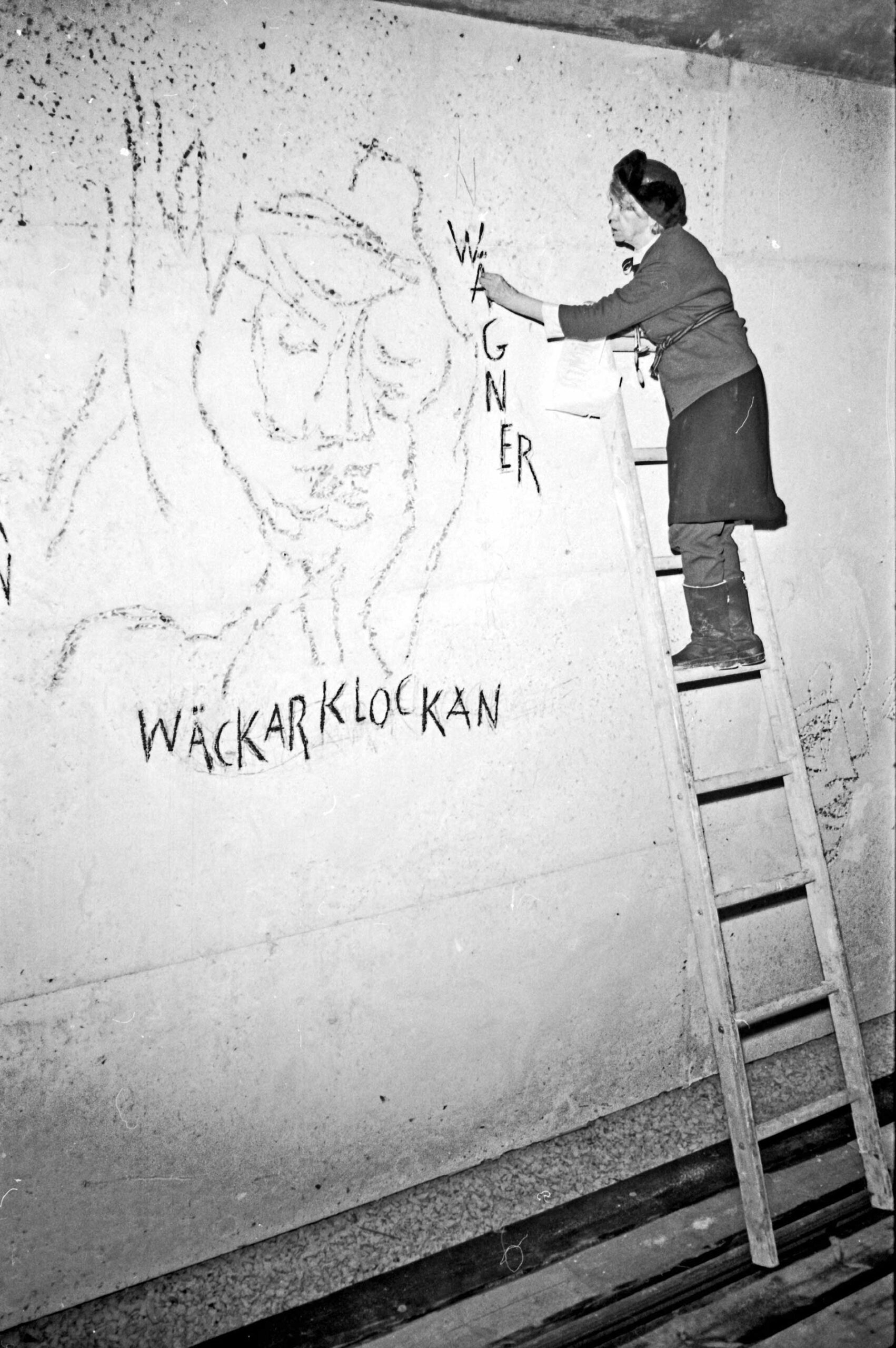
In October 1962, Nesjar visited Stockholm to meet the Swedish artist Siri Derkert, who had recently won the public art commission for the new subway station of Östermalmstorg. Derkert planned to decorate the station with two 145-meter-long panels of naturbetong stretching the length of the platform, sandblasted with her expressionist motifs.[32] The artwork took inspiration from the women’s rights, peace, and environmental movements, with figures including Rachel Carlson, Simon de Beauvoir, Albert Einstein, and Jean Paul Sartre etched into the concrete surface. Nesjar was to assist the then 77-year-old Derkert with the technical aspects of the project and provide consultation on the sandblasting process [Image 10-11]. It was here while in Stockholm that Nesjar met with Pontus Hultén at the Moderna Museet, and the initial idea to host an exhibition on art in concrete began to develop.[33] Nesjar had a close friendship, and productive working relationship with Pablo Picasso, with the two artists collaborating on a series of large-scale concrete sculptures. Picasso would provide sketches or small models, which Nesjar then transcribed into full size concrete forms.[34] This collaboration led him to work on projects all over Europe, including several private commissions in France, as well as a wall frieze for the College of Architects in Barcelona. Pontus Hultén, as director of the Museum of Modern Art, was tasked with building up the young institution’s permanent collection and regarded a Picasso/Nejsar sculpture as a self-evident addition to the sculpture garden. In 1963, Hultén approached Nesjar with a more formal proposal, inviting him to construct a Picasso sculpture for the forthcoming exhibition Konst i betong—with the explicit aim of later purchasing the sculpture for the museum’s permanent collection. The sculpture, originally titled Figure Découpée, but renamed Fågelfisken (The Bird Fish) for the exhibition, was based on a design previously executed by Picasso and Nesjar for the Mur Vivant exhibition at the Grand Palais in Paris in 1963—an exhibition visited by Hultén, which also showcased possibilities for collaboration between art and architecture. Following Konst i betong,however, the board of the museum did not grant permission to acquire Fågelfisken for their permanent collection and the sculpture was sold to the City of Helsingborg in southern Sweden, where it was installed on a wall in the new municipal housing estate of Norlunda.[35]
The Material Legacy of Concrete
The mid 1960’soffers a fascinating vantage point from which to explore the entangled aesthetic, political, and industrial dimensions of concrete at a critical juncture point in the historical development of the Swedish welfare state. As architectural historian Adrian Forty has remarked, it’s “more productive to think of concrete as a medium than as a material … a medium through which all sorts of ideas, some of them architectural, have been communicated.”[36] The era in Sweden could be considered that of “peak concrete” as production of the material surged to keep apace the booming construction industry. When a political consensus concerning housing policy was achieved within Socialdemokraterna in the summer of 1964, the material of concrete was strategically placed to rise to the task. Through a concerted, but by no means formally organized, effort by political, economic, and cultural forces, concrete became the hegemonic material of the expanding welfare state. Innovative builders such as Ohlsson & Skarne and other members of the D4 group had already proven the structural and economic case for prefabricated concrete panel construction through extensive built work, utilizing a variety of methods, machines, and models. Simultaneously, artistic and architectural experimentation using unadorned concrete, illustrated by work put on display at Konst i betong, nurtured a social and cultural acceptance of the material. Large-scale public artworks in concrete by the likes of Pablo Picasso, Carl Nesjar, and Siri Derkert, gave the material extra legitimacy, as well as increased media coverage. In the 1960s, concrete became a medium through which the hopes and ideals of the welfare state received a tangible form—where the promise of progress, prosperity, and the good life could be grasped and experienced. For a brief moment in time, the material presented new possibilities to politicians, builders, architects, engineers, curators, and artists alike. The plastic, malleable, moldable properties of concrete left it wide open to multiple interpretations, dreams, and ambitions. In concrete, each could imagine their own version of a better future, and as such, it was perfectly suited to the task of constructing the welfare state—a “people’s home” for all, to quote Socialdemokraterna’s oft-repeated “Folkhemmet” adage. Yet as the contested legacy of welfare-state era architecture reveals, narratives can easily shift, political ideologies change, and new economic regimes emerge. If concrete was once a medium associated with positive images of progress and prosperity, today the material carries the collective burden of societies’ perceived failures. However it’s important to emphasize that industrialized and prefabricated concrete element construction still provides affordable housing to thousands of Nordic residents, often those with the least means. The promise is somewhat kept, albeit in a radically reduced scope. Maybe it’s time to rethink the material legacy of the welfare state and see its concrete built form as a gift — a collective inheritance bequeathed to society—rather than a burden we must rid ourselves of at once.
Notes:
[1] In Denmark the term “ghetto” was officially used in government planning documents to refer to socially and economically disadvantaged neighborhoods with a high proportion of residents from a non-European background.
[2] Swedish Original: Betong är ren mötesplats för arkitekt och konstnär. “(T)ung Konst,” Dagens Nyheter, May 5, 1964, 11;
[3] Pontus Hultén and Olle Rinman, Konst i betong [Concrete art] (Stockholm: Moderna Museet, 1964), 5. Published in conjunction with an exhibition of the same title.
[4] “Konst i betong” [Concrete art], Dagens Nyheter, May 21, 1964.
[5] “Jubilerande Vägbyggare” [Jubilant road builders], Dagens Nyheter, May 17, 1964, 9.
[6] Skarne System International, company catalogue, 1967, in the Skarne Family collection of Erik Stenberg’s Million Program Archive.
[7] Original quote in Swedish: “Klart att rationalisering av byggande kräver rationell planering och det bör ger arkitekterna mer tid att ägna sig åt de verkligt stora uppgifterna — att forma vår inre och yttre bostadsmiljö och att ge den i arbetslivet hårt pressade nutidsmänniskan en fritidsmiljö som skänker både ro och stimulans.” Alan Skarne, “Från Hantverk till Byggnadsindustri, 1965” [From craft to construction industry] in Med kran och krok [With Crane and hook] (Stockholm: Ohlsson & Skarne Byggförlag, 1987), 23.
[8] Press release from the archive of Svenska Väg- och Vattenbyggares Riksförbund. SE/RA/730307/10/01/E/E 5/2.
[9] “Statens bostadspolitik får kritik i SAP-debatt” [State housing policy critiqued in SAP debate], Dagens Nyheter, June 10, 1964, 28.
[10] Statens offentliga utredningar (SOU), Höjd bostadsstandard [Raised building standards] (Stockholm: SOU, 1965), 32.
[11] “Rationalisering Strängs lösen” [Rationalization is Sträng’s answer], Dagens Nyheter, April 21, 1964, 10.
[12] “Rationalisering,” 10.
[13] Kurt Månsson, ”Integrated Housing Construction,” Byggnadsindustrin 10 (1960): 571-575.
[14] B. Isaksson, Statens Pris- och Kartellnämnd, Byggnadsutredning, Bilaga 2 [The Swedish Competition Authority, Construction Report, Appendix 2], (SPK: Stockholm, 1964).
[15] Gösta Andersson, “Flerfamiljshus med stommelement av betong” [Multi-family house with frame element in cocrete], Byggmästaren 6 (1968): 24-35; and Gösta Andersson, ”Svenska elementbyggsystem för flerfamiljshus 1” [Swedish element-based construction system for multi-family housing 1], in Byggforskningen informerar 7, Statens institut för byggnadsforskning (1968).
[16] Erik Stenberg, “D4 Gruppen 1955-1961,” in Flying Panels: How Concrete Panels Changed the World (Stockholm and Berlin: ArkDes and DOM Publishers, 2019).
[17] Skarne, Med kran och krok, 9.
[18] R.M.E. Diamant, “The Bollmora System – 10,” Architect and Building News, May 16, 1962, 720-722.
[19] Ohlsson & Skarne, ”Typ Skarne 66: Typhus med flexibla och elastiska lägenheter konstruerad enl. System S-66” [Type Skarne 66: A type ouse with flexible and elastic apartments constructed using System S66], an unpublished drawing set from the Janne Lundquist collection of Erik Stenberg’s Million Program Archive.
[20] Skarne, Med kran och krok, 130.
[21] The Swedish Council for Building Research and Skarne Systemutveckling, “The Convertible Building” (Uddevalla: The Swedish Council for Building Research and Skarne Systemutveckling, 1988).
[22] Original quote in Swedish: ”system S85 är en beteckning med teknisk klang. i själva verket gäller det en bebyggelse som har starka beröringspunkter med den gamla svenska småstaden, en tät låg, enhetlig men rikt varierade bebyggelse som bildar ramen kring stadens boende och verksamhet.” Skarne et al., Med kran och krok, 132.
[23] Skarne et al., Med kran och krok, 111.
[24] Original quote in Norwegian: “Betongen er vår tids viktigste byggemaleriale. Den har brutt steinens og treets hegemoni. Men dermed er ikke sagt at vi ennå fullt ut behersker betongen, eller at vi konsekvent har latt dens spesielle egenskaper få fritt spill i var arkitekturs formgivning, eller at vi helt har utnyttet dens muligheter konstruktivt og estetisk.” Carl Nesjar, Konst i betong, 7.
[25] Original quote in Norwegian: “at kunsten både idemessig og materialmessig er en del av arkitekturen.” Carl Nesjar, Konst i Betong, 7.
[26] Swedish original: “Traditionellt har konstnärerna förskönat våra samhällen och stadsdelar i efterhand—när arkitekterna och byggarna gjort sitt. Betongen har givit dem möjligheter att deltaga i skapandet från början.” Hultén and Rinman, Konst i betong, 4.
[27] Hultén and Rinman, Konst I betong, 63.
[28] Sally Fairweather, Picasso’s Concrete Sculptures (New York: Hudson Hills Press, 1982), 31.
[29] Erling Viksjø, “Et nyt byggemateriale med mange muligheder” [A new building material with many possiblities], Ingeniørens Ugeblad (December 1958): 6.
[30] Viksjø, ”Et nyt byggemateriale,” 6.
[31] Viksjø, “Et nyt byggemateriale,” 6.
[32] Karin Hermerén and Henrik Orrje, Offentlig Konst: Ett Kulturarv [Public art: a cultural inheritance] (Stockholm: Statenskonstråd, 2014), 249-255.
[33] Swedish Original: “Och, som sagt, diskussionerna med den stora gamla på Rivieran, om skulpturer stora som hus, och hus. Vem vet, nog kan det finnas plats för ett på Skeppsholmen … .” Guat, “Picasso i Naturbetong” [Picasso in natural concrete], Dagens Nyheter, October 10, 1962, 15.
[34] Fairweather, Picasso’s Concrete Sculptures, 31.
[35] Fairweather, Picasso’s Concrete Sculptures, 71.
[36] Adrian Forty, Concrete and Culture: A Material History (London: Reaktion Books, 2012), 10.