Gentrification of the Mined
Written for Lo-Res Journal, Volume 2. 2016.
There is no such thing either man or nature now, only a process that produces the one within the other and couples the machines together. Producing-machines, desiring machines everywhere, schizophrenic machines, all of species life: the self and the non self, outside and inside, no longer have any meaning whatsoever.
Deleuze and Guattari[1]
“A Plunge into Real Estate”[2]—the evocative title of Italo Calvino’s novella seems as pertinent today as when it was first published in 1957,conjuring up images of that deep viscous pool which engrosses us so much, where all conversations appear to drain; a kind of “Godwins law”[3] where the longer an exchange endures the probability of discussing some aspect of property approaches certainty—record housing prices, housing shortages, decade long rental queues, high rise development, low rise development. Everyone has an opinion because everyone has a stake in the game, none more so than architects and planning professionals who find themselves intrinsically involved in the production of this form of immovable property. Their role in the process however, is becoming ever more marginalised, squeezed between the construction heavyweights on one side, and the hungry packs of marketers, PR professionals and realtors on the other. Is it still possible to imagine an alternative to the current regime of banal neoliberal urbanism being propagated, or is it already game over?
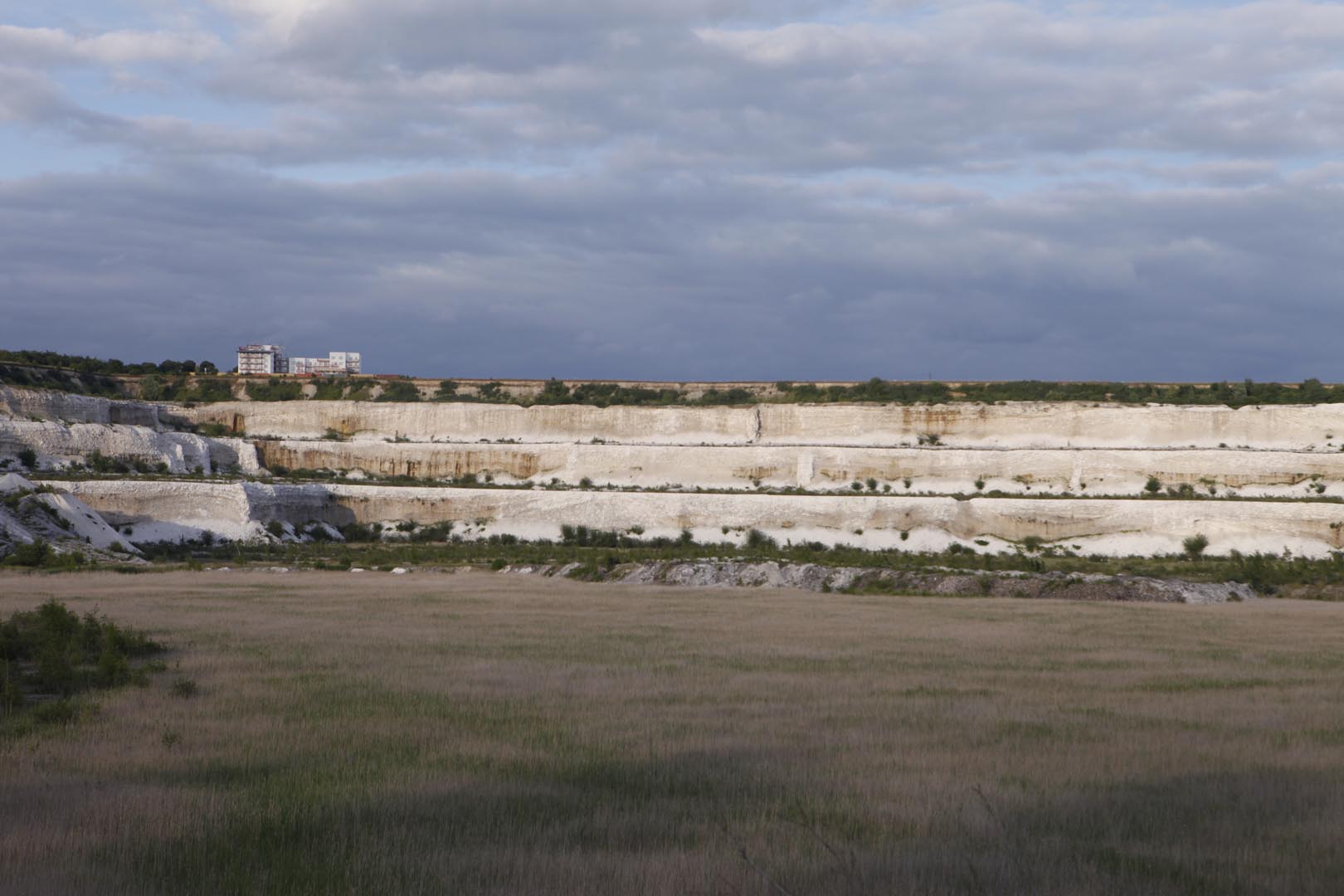
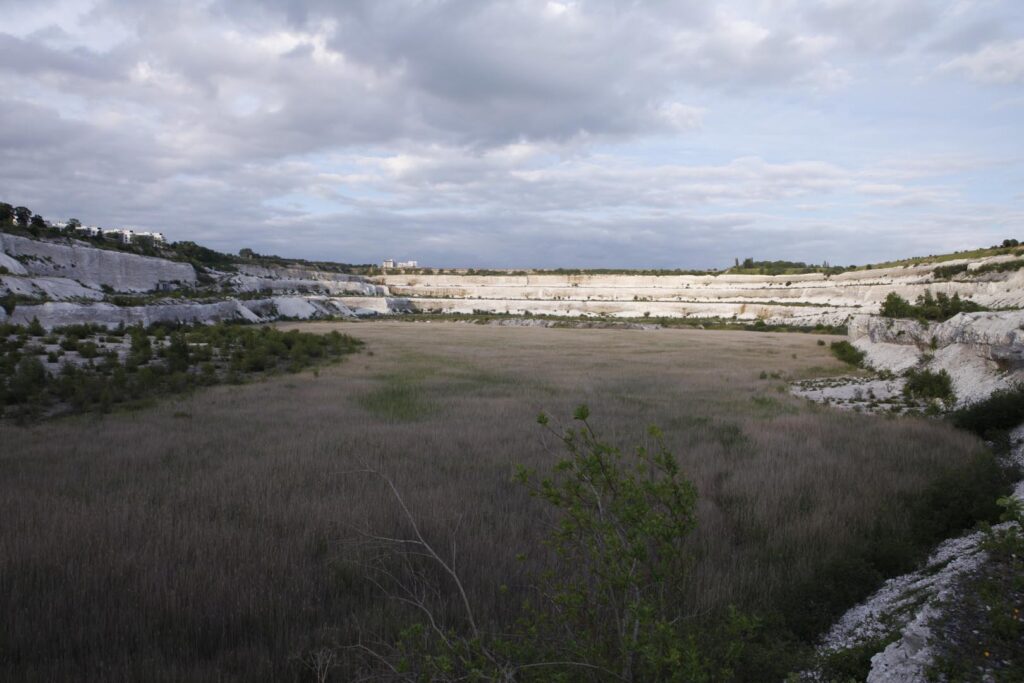
This story substitutes the lush Ligurian hills above the Mediterranean sea of Calvino’s tale for the cold, windswept plains of southern Skåne. The speculative territory of the Öresund region, between the swelling consumer city of Emporia and the transnational infrastructural apparatus of the Öresund bridge.[4] A modest peripheral landscape of suburban villas, allotment gardens and cultivated fields suddenly interrupted by the monumental sunken hollow of an abandoned limestone quarry. The earthly consequence of the production of real estate. This ghostly void is an archive of the Swedish construction industry recorded in the earth—every boom and bust registered in its striated layers of rock, its scattered contents preserved in countless buildings throughout Sweden. The last load of limestone destined to become cement was removed from the site in 1994 ending well over a century of continuous industrial quarrying, but this was by no means an end to production; focus merely shifted from the material production of real estate to the more speculative variety.
Production of Desire
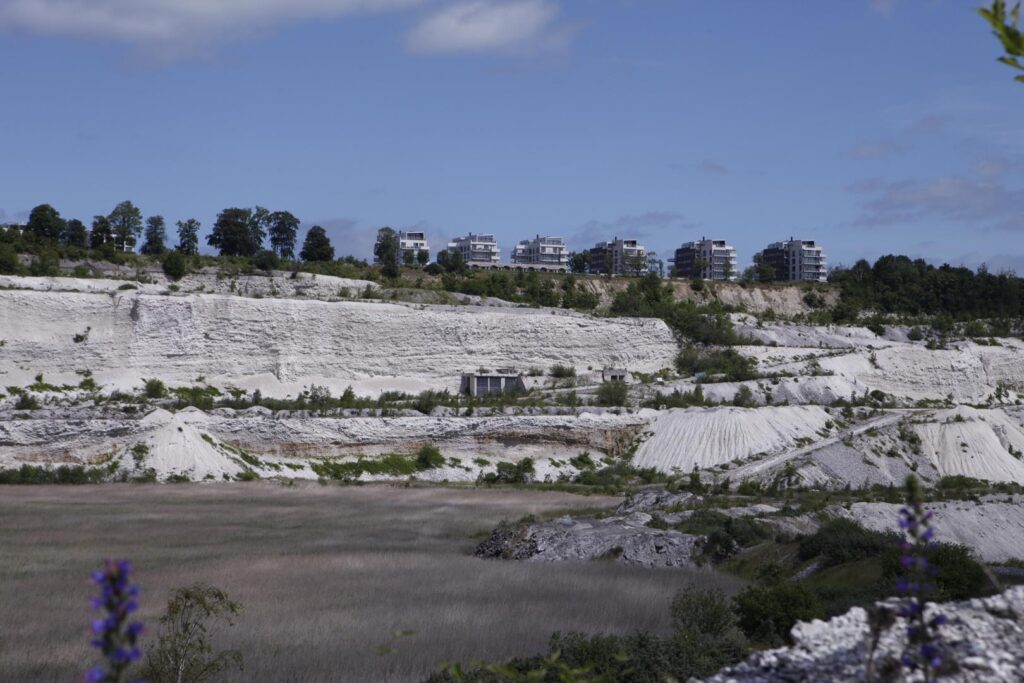
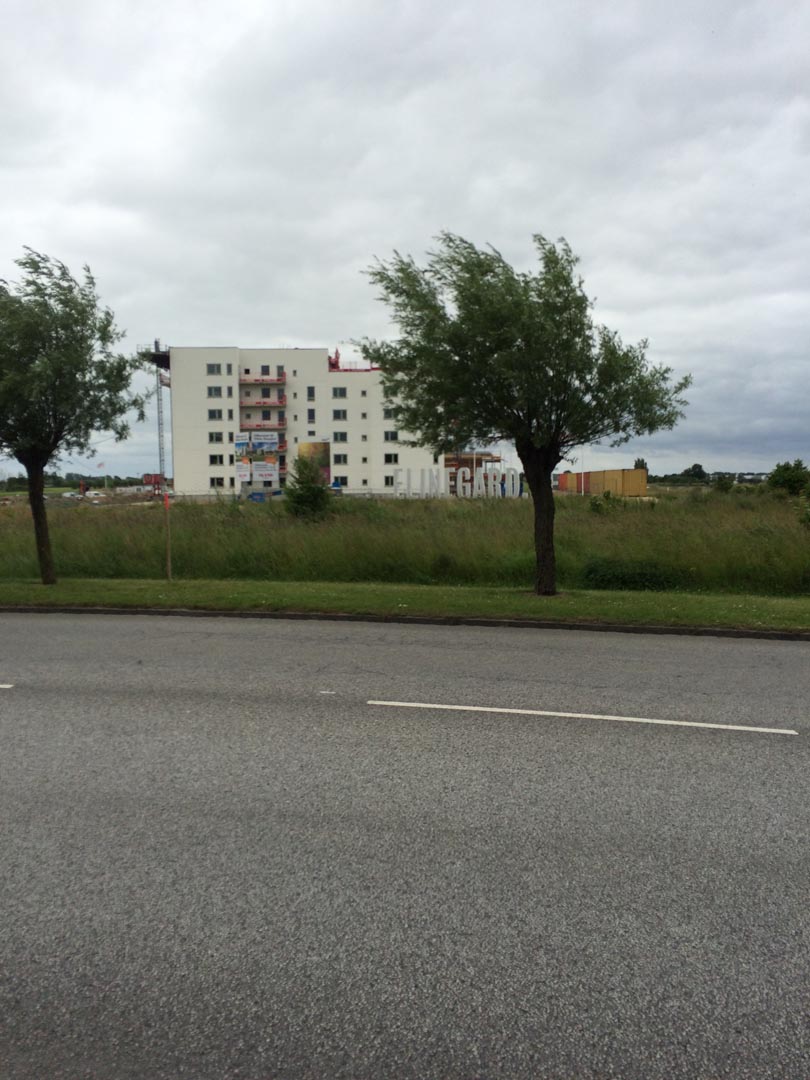
Rapidly rising up along the eastern rim of this exhausted caldera are a small cluster of bulky white forms, joining an established ensemble of somber concrete sentinels stationed along the northern edge. These emerging structures will eventually make up part of a planned residential neighbourhood known as Elinegård, currently being built by Ikano Bostad and NCC, which when complete will house an estimated 4000 residents in 2000 dwellings.[5] The arrival of this new urban force was boldly announced early during the summer of 2015 through a coordinated advertising blitz in which a plethora of pea-green posters were smeared around the city of Malmö. Intriguingly though, these posters were not saturated in the evocative imagery usually accompanying speculative urban development; those carefully choreographed scenes of life set to a backdrop of polite contemporary architectural forms. The advertisement took a rather fresh approach, announcing in bold type the launch of a photographic competition running on the social media platform Instagram. Simply affixing the hashtag #skönarestadsliv, Better Urban Life to any photograph uploaded onto the social media application placed users in the running to win a holiday to Barcelona; an urban destination obviously perceived to espouse the qualities of the good urban life so eagerly desired.[6]
Utilising the frictionless networked world of social media, the entire production, distribution and consumption of these images of exchange are managed by the consumer-user themselves. The images generated by this Instagram campaign are not objects, but rather ‘processes of production’ which are then appropriated by the urban brand that is Elinegård for its own marketing intentions.[7] In this way Elinegård does not need to generate its own catalogue of enticing imagery in order to sell its real estate, but rather acts as what Deleuze and Guattari call a body without organs, serving “as a surface for the recording of the entire process of production”.[8] Distribution is facilitated by the consumer-user as they spread these images across their integrated social networks – every share, like and comment adding a surplus value to the “better urban life” hashtag as it ripples through the system, recruiting new ‘producers’ in the process. The task of editing, cropping and reworking these images is left entirely to the users as they employ the inbuilt tools of Instagram; adjusting contrast, brightness, saturation, adding a vignette or an ethereal filter—a skill many have become extremely adept at in their habitual use of the social media platform.
An exhaustive series of heterogeneous images, like a vast digital patchwork quilt is generated from this marketing campaign, with each small square photograph stitched together with another, and another, and another, with no regard for content, organisation or category—the hashtag “better urban life” is the sole common denominator which binds these disparate objects together. A tree, a beach, a boat, a skyscraper, children jumping off a wharf, a flower garden, horses, a narrow city lane, a glass of wine, a dog, and, and, and… A coded language of images and signs where “the one vocation of the sign is to produce desire, engineering it in every direction.”[9] The objective of this marketing campaign is not to select one image which can embody a “ Better Urban Life” but rather to extract a surplus from the code itself, and through entering the competition using the hashtag #skönarestadsliv, users have either knowingly or unknowingly transferred ownership rights of their photographs to Elinegård for perpetuity.[10] If the aim is to extract value from the code, then its better to own the code.
It would be all too easy for us urban practitioners to mock a slogan such as a “Better Urban Life” from the comfort of our inner city abodes, but to do so would be naive. We should instead take such a statement very seriously. Elinegård’s main developer, Ikano Bostad is after all, a subsidiary of IKEA—the furniture giant often credited with inventing the concept of a ‘lifestyle brand’ and an extremely successful engineer of desire. Ikano Bostad has been aggressively expanding its real estate portfolio over the past few years, bulk buying large urban areas in Malmö and Stockholm as well as increasing its own production of new housing, positioning itself as a formidable new force in the property industry.[11] The purpose of this Instagram campaign as well as subsequent marketing stunts by Elinegård (such as giving away tomato plants with“Better Urban Life” recipes attached and using a series of Elinegård branded bicycle taxis to move people around the city during a cultural event) is not intended purely to sell a particular apartment or piece of real estate, but rather to manufacture a desire for a particular lifestyle, in this case the urban lifestyle, hijacking the word urban to serve the libidinal economy of consumer capitalism. Something Roemer van Toorn calls the “suburbanisation of our imagination”, where the“experiential landscape we live in has become synthetic, fabricated nature. Actually, for us, the synthetic approximates the natural.”[12] The Better Urban Life to be desired at Elinegård becomes a synthetic imitation of the already synthetic gentrified urban cores of our inner cities, where the urban is reduced to a simple formula, which can be branded and reproduced in the tidy package of a lifestyle ready for consumption. The city becomes a product; a closed system bringing all human activity into the domain of the market through the production of collective desires we consume as individual tastes and lifestyle choices. Ikea has taken its extremely successful retail strategy and applied it on an urban scale. “The ideology of consumption,” as Manfredo Tafuri remarked “must be offered to the public as the correct use of the city”.[13]
Mechanisms of Speculation
Even in our turbocharged cyber capitalist age where real estate holdings are routinely fragmented, translated and packaged into financial products to be traded at nanosecond intervals in the digital ether, they are still fundamentally based on a patch of land situated somewhere. At Elinegård, 32 hectares of fertile agricultural land is in the process of being transformed into 2000 individual units of real estate. Land is a finite resource which cannot easily be produced, but real estate appears to have an infinite potential for growth, provided it is first sanctioned by what Wouter Vanstipout calls “dark matter”—that complex apparatus of government, planning departments and large scale institutionalised developers who have the power to form the city.[14] In order to understand how real estate is capable of reproducing itself through a process resembling the binary fission of bacteria, we need to engage with this “dark matter” and explore how the mechanisms of speculation operate. Elinegård, along with the other developments going up around the peculiar post-industrial site of the quarry are not the result of rampart unfettered property speculation (this is Sweden, there are rules to be followed), but rather the intended outcome of a well executed strategy which has been years in the making.
To trace the origins of the transformation of the limestone quarry from a producer of raw building material to a producer of real estate, we need to go back to the mid 1970’s. After almost 25 years of continual economic growth, Sweden’s economy began to slide into recession, joining the economic stagnation experienced by most of Western Europe following the oil crisis of 1973. The recession decimated the industrial base of the city of Malmö, wiping out the textile industry and crippling the shipbuilders (Malmö’s population actually shrank by 12% between 1970 and 1980). The construction industry was also hit particularly hard, coming down from the frenzied activity of the million program years (1965-1974), with demand for cement and limestone products significantly reduced. It was in this depressed climate in 1976 that Euroc’s CEO Sten Lindh (Euroc being the company owning and operating the limestone quarry and cement factory), made the decision to move the company’s corporate headquarters from its inner city location to a new office building on the edge of the quarry, designed by renowned local architect Sten Samuelson (Euroc House, completed 1978) stating that the move would give the organisation the opportunity to “reconnect with its past and prepare for the future.”[15]
With the city on the edge of economic ruin and politicians scrambling for a fix to reduce soaring unemployment and an exodus of people, Lindh was taking a gamble; that the crisis would reignite interest in the Öresund bridge project. A fixed link between Denmark and Sweden had been proposed several times previously but it took a special kind of crisis to bring together the different layers of government and planning from both countries necessary for such an ambitious project. It would linger until 1991 to reach an official agreement between the two nations to commence construction but Euroc had already taken the plunge into the real estate business, enlisting Sten Samuelson to draw up a visionary urban plan for the quarry site as early as 1987. Euroc City, as the project was called, would house 15 000 people in terraced apartments centred around the drowned remains of the quarry, and also included a spectacular proposal to build a 30 story hotel on an artificial island in the Öresund.[16] The project was even put on display in the company’s corporate headquarters—briefly transforming it into what we would recognise today as a real estate display office.
The eventual decision to construct the Öresund bridge set in motion a wave of speculation across both sides of the strait, clearly evidenced today by the montage of warped architectural forms seen flickering past during the 35 minute train journey between Malmö and Copenhagen.[17] Euroc secured an agreement with the municipality in 1992 allowing for 200 000 square metres of commercial and residential development on its land encompassing the limestone quarry but the larger urban visions were interrupted by the incoming Social Democratic government of 1994 who decided instead to direct its attention toward the urban renewal of the crumbling dockyards. Another attempt to reanimate the project was made in the late 1990’s under the fresh name Scanstad (referencing the new name of the company, Scancem), drawn up by Peter Broberg of Landskronagruppen, but this new incarnation also failed to gain traction with the city.[18] Tactics were altered after Scancem was acquired by the German cement giant Heidelberg in 1999, with the new owners seemingly less interested in pursuing a career in real estate and more interested in selling their remaining assets at the now disused site. An agreement was finally reached with the municipality in 2005, giving the company additional development rights in exchange for donating the sunken quarry site to the city to be preserved as a nature reserve. The land upon which Elinegård is being built was sold to the developer NCC in 2008 under the assurance the municipality would approve construction of 500 new dwellings on the site; they approved 2000.[19] The forces of dark matter are mysterious and unpredictable.
Though the quarry would continue to provide crushed limestone to the cement kilns at Limhamn until 1994, its fate as a site of building material production was paradoxically sealed with the completion of Euroc House in 1978. The conclusion of the million program several years earlier brought an abrupt end to state subsidised housing production, and companies which had grown fat during the period now had to readjust to this new globalised world. Skånska Cement, which began as a humble local cement producer in 1871 would become Cementa in 1969,Euroc in 1973, Scancem in 1996 and finally Heidelberg Cementa in 1999 – Each name change signaling a new merger or acquisition, an expansion into new territories, access to new sites of production. Suddenly the quarry which started the whole affair becomes a peripheral asset in the ever evolving corporate structure; a couple of numbers on a spreadsheet which the accounting department concludes has more value as a land asset than as material reserve. Production can always shift to another location; Gotland, Estonia, Poland, Kazakhstan—there’s always somewhere further afield with cheaper wages and less regulation. The old industrial base of Malmö has now been replaced by the “knowledge economy” (although exactly what type of knowledge this entails is rather ambiguous)— shipyards become media centres, textile mills become shopping malls and the limestone quarry becomes a nature reserve enclosed by a ring of exclusive residential neighbourhoods—housing for the creative data miners of the information age.
Conclusion
Real estate is essentially a continuous flow of production which is fed and worked upon by a multitude of autonomous yet interconnected machines—digging machines, crushing machines, mixing machines, moving machines, engineering machines, planning machines, architectural machines, financial machines, marketing machines, selling machines. Every machine, according to Delueze and Guattari “functions as a break in the flow in relation to the machine to which it is connected, but at the same time is also a flow itself, or the production of a flow, in relation to the machine connected to it.”[20]The flow of desire emanating from the marketing machines of Elinegård will feed the advertising machines which will feed the selling machines, which will eventually feed the debt machines and so on. But at the same time, the marketing machines are dependent on a continuous flow of production from the construction machines, the architectural machines, the planning machines, the government machines, the mining machines. The immaterial forces of real estate are still reliant on a continual flow of material production—even images posted on Instagram are still producing holes in the ground somewhere, each pixel generated on a screen corresponding with a tiny fragment of displaced earth.
Architecture is just one machine in the long chain of production, but it is becoming increasingly difficult to alter the direction of the flow, to contest the regime of neoliberal urbanism from our current position. If we accept that “Everything is Architecture”[21] but at the same time “Everything is Production”[22] than we realise that every process in the production of real estate has a real spatial consequence, from the extraction of raw building material to the digital marketing campaigns of developers. If we still have any hope of imagining an alternative future than we must involve ourselves with these other sites of production, to re-engage with the ‘dark matter’ of planning and government, the mines, quarries and forests that feed our buildings, and the algorithms and social media networks that feed our imagination.
Notes:
[1] Gilles Deleuze and Felix Guattari, Anti-Oedipus: Capitalism and Schizophrenia (London: Penguin books, 2009), 39.
[2] Italo Calvino, “A Plunge into Real Estate,” in Difficult Loves (London: Random House, 1999)
[3] Godwin’s law (or Godwin’s rule of Nazi analogies) is an Internet adage asserting that “As an online discussion grows longer, the probability of a comparison involving Nazis or Hitler approaches 1”
[4] Emporia is Currently Scandinavia’s largest shopping mall at 93 000 square metres with approximately 200 stores. The mall is owned and operated by the real estate investment firm Steen & Strøm, and was designed by the renowned Swedish architect Gert Windgårdh. In 2014 the mall had an estimated 6.2 million visitors and a yearly revenue of 2.5 billion SEK. In November Emporia will be relegated to Sweden’s second biggest mall after the opening of Mall of Scandinavia in Stockholm. Source: www.steenstrom.com/se/property/empora
[5] These are the figures quoted on Elinegård’s website; www.elinegård.se. The first stage of development currently under construction at the northern edge of the site scheduled for completion in 2016 consists of 65 apartments in Ikano’s Brf Ofelia, 21 in NCC’s Agorahusen and 45 in NCC’s Trollsländan.
[6] I have translated Skönare stadsliv to “better urban life” in this essay, which although not necessarily the most faithful translation, best captures what I believe to be the true essence of the Swedish marketing slogan in English. Alternative translations include; Nicer Urban Life, Nicer City Life, A More Pleasant City Life. A more Awesome Urban Life, etc. The advertising campaign can be viewed online at www.elinegard.se
[7] Gilles Deleuze, quoted in Hélène Frichot, Gentri-Fiction and Our (E)States of Reality: On the
Fatigued Images of Architecture and the Exhaustion of the Image of Thought, in: The Missed Encounter of Radical Philosophy with Architecture, edited by Nadir Lahiji (London: Bloomsberg Publishing, 2014).
[8] Gilles Deleuze and Felix Guattari, Anti-Oedipus: Capitalism and Schizophrenia (London: Penguin books, 2009), 11.
[9] Ibid.,39.
[10] An excerpt from Elinegård’s competition rules on image policy and copyright:
By submitting your entry to the contest and hashtags with # better city life, you certify that the image is your own. You also transfer the copyright of the image to Elinegård. Elinegård have the right to publish the winner by name. You also agree that your rights to the image cease, and that Elinegård may use the image without any limitation in time, in any manner within Elinegård’s operations and in accordance with Swedish law and good practice.
(Source: www.elinegard.se)
[11] Ikano Bostad is subsidary of Ikano Group, a private company based in Luxemburg founded by Ingvar Kamprads sons, Peter, Jonas and Mattias Kamprad.
[12] Roemer Van Toorn, Rethinking the City Spectacle in LINZ/TEXAS: A CITY RELATES Editors Angelika Fitz, Martin Heller, 2009
[13] Manfredo Tafuri, Architecture and Utopia: Design and Capitalist Development (Cambridge MA: MIT Press, 1976), 83.
[14] Wouter Vanstiphout interviewed by Rory Hyde from Future Practice: Conversations from the Edge of Architecture (London: Routledge, 2012).
[15] Thomas Stenson, Mot en ny tid: hela historien om Euroc under den stora strukturomvandlingen 1972 – 1996 (Malmö: Scancem, 1997).
[16] 16. ibid.
[17] For an in depth account of the mechanisms of speculation which helped shape the skyline around Hyllie on the Swedish side of the bridge, see Fredrick Torrison’s essay “An essay about nothing” in the pilot issue of Lo-Res, 46.
[18] “Det snåriga avtalet en paketlösning med åtta pusselbitar,” Sydsvenskan, April 18, 2008.
[19] Kaj Norborg, En Stad Växer upp i Limhamns Kalkbrott, in; Limhamniana, 2001, 20–23.
[20] Gilles Deleuze and Felix Guattari, Anti-Oedipus: Capitalism and Schizophrenia (London: Penguin books, 2009), 36.
[21] “Everything is Architecture” (Alles Ist Architektur) is the polemic text by Hans Hollien which appeared in the 1968 edition of BAU journal, accompanied by a series of collages, photographs, cut-ups and photomontages illustrating a diverse variety of everyday objects, often given a monumental architectural scale.
Also see Jack Self’s recent article “Is Everything Architecture?” (The Architectural Review, August 2015)
http://www.architectural-review.com/view/reviews/is-everything-architecture/8687378.article
[22] “Production is immediately consumption and a recording process without any sort of mediation, and the recording process and consumption directly determine production, though they do so within the production process itself. Hence everything is production: production of productions, of actions and of passions; productions of recording processes, of distributions and of co-ordinates that serve as points of reference; productions of consumptions, of sensual pleasures, of anxieties, and of pain. Everything is production, since the recording processes are immediately consumed, immediately consummated, and these consumptions directly reproduced.
Gilles Deleuze and Felix Guattari, Anti-Oedipus: Capitalism and Schizophrenia (London: Penguin books, 2009), 4.