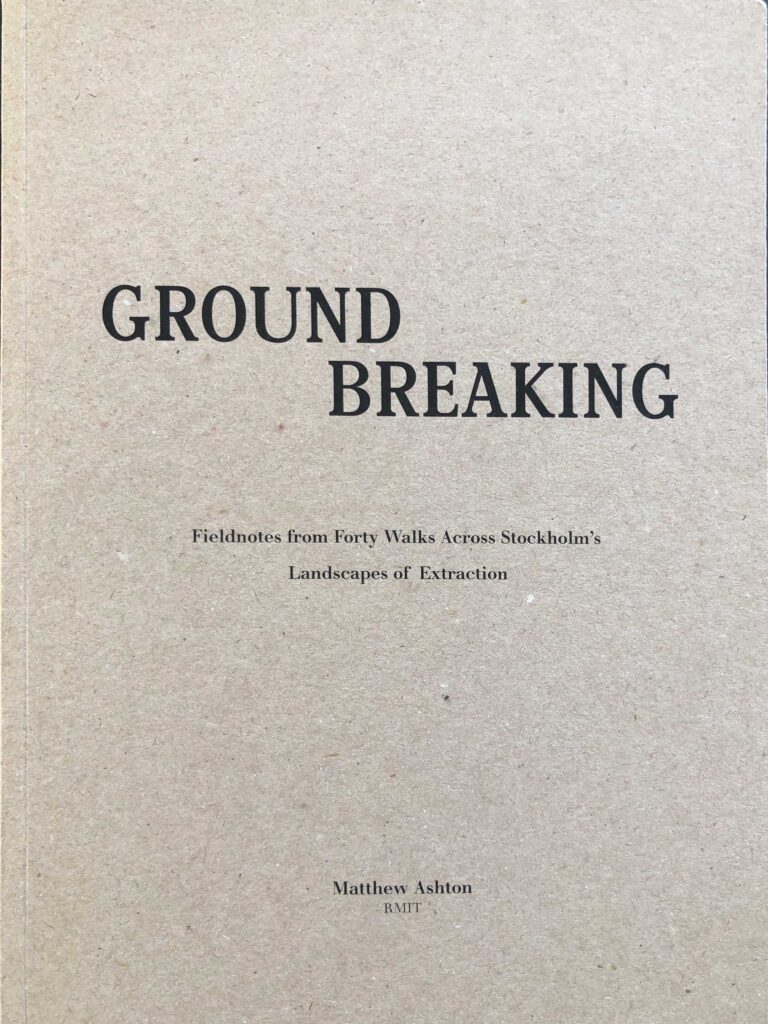

Groundbreaking: Fieldnotes from Forty Walks
Across Stockholm’s Landscapes of Extraction
Matthew Ashton, PhD Dissertation
RMIT University, Melbourne, 2025
ISBN: 978-91-527-3661-6
180mm x 240mm, 446 pages
Design: Matthew Ashton
Printed: US-AB, Stockholm, Sweden
DOI: https://doi.org/10.25439/rmt.29880320
Abstract
Groundbreaking: Fieldnotes from Forty Walks Across Stockholm’s Landscapes of Extraction takes “breaking ground” as a lens from which to explore the dialectical relationship between acts of building, and their broader territorial entanglements. Every act of building is intertwined with multiple forms of destruction, unfurling at varying scales and intensities throughout time and space—from the tangible transformations brought about by excavation, demolition, and new construction, to the more removed ruination caused by mining and resource extraction, the accrued concentrations of carbon released into the atmosphere, and the gradual seepage of toxins into seas, lakes, and groundwater. Following the flows of broken earth—the mundane materials of sand, gravel, crushed rock, and excavation waste, otherwise known as building aggregates—I embark upon an intrepid exploration of the myriad landscapes of extraction scattered throughout the hinterlands of the city of Stockholm. Observing what is actually happening in the mud and fine-grain of the ground, “paying attention” to material flows, and reading the neglected stories embedded in the landscape, I ask what can we learn from these places?
The act of “following” is a thread which weaves through the entire PhD, tracing material flows on the ground in the form of a creative walking practice. Walking becomes a means of entering these “landscapes of extraction,” perceiving their enduring processes of transformation, and becoming attuned to their social, material, and ecological entanglements. To walk is to be grounded, partial, and subjective, open to the unexpected and the unintended. It’s a method of artistic research practice which cultivates a form of spatial intimacy—a way of being-in-the-world—engaging the body as a sensory recording device to read and transcribe one’s surroundings. Over the course of forty individual walks across the peripheral spaces of Stockholm I developed a distinctive practice of walking, and this PhD offers a reflection on those experiences, building a walking methodology that has the potential to generate new knowledge, different ways of seeing, and different ways of being in the world.
What follows is a collection of walks, essays, stories, photographs and fieldnotes gleaned from forty walks across Stockholm’s landscapes of extraction that together form a rich and nuanced narrative of a complex territory in a continuous state of transformation.