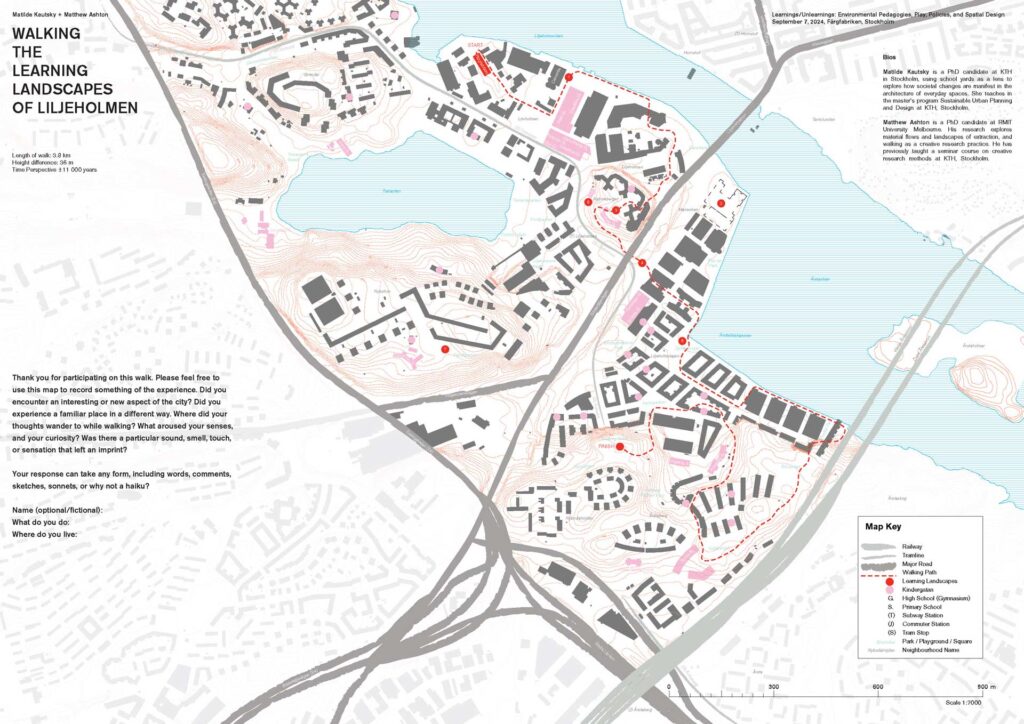
Walking the Learning Landscapes of Liljeholmen
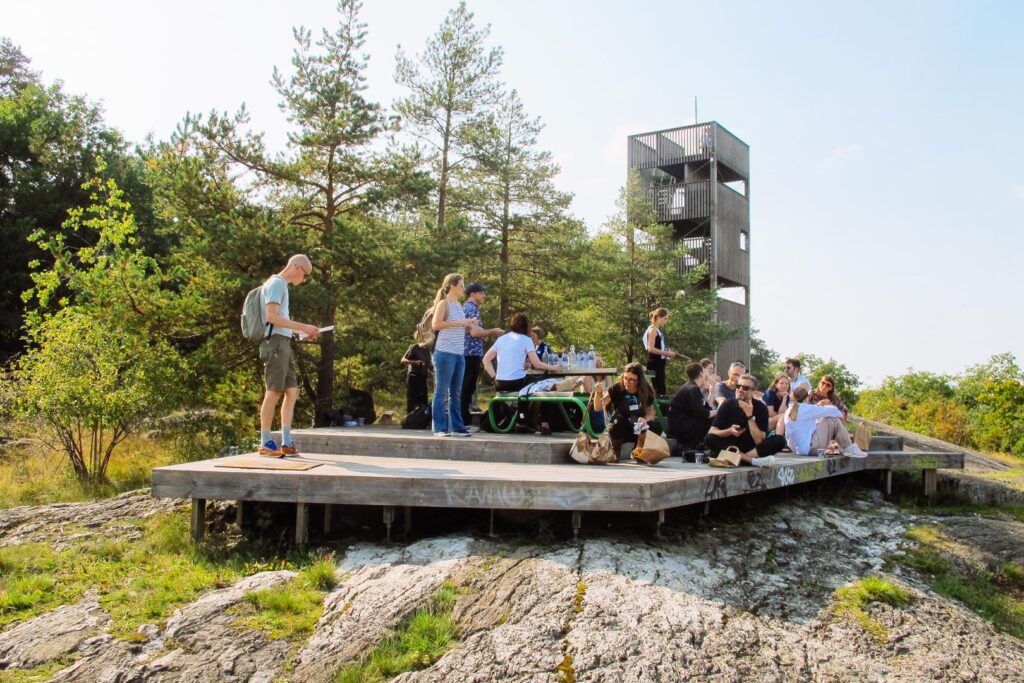
Walking Workshop organised together with Matilde Kautsky, held at the conference “Learnings/Unlearnings: Environmental Pedagogies, Play, Policies, and Spatial Design,”
Stockholm, 7 September 2024
Cities are strange organisms. They are, by their nature, messy, mutating, and inherently unfinished —sites of continual construction and destruction, decadence and decay, obsolescence, and renewal. David Harvey and Laura Grace Ford both invoke the metaphor of the “palimpsest” to describe the nature of cities, of the many “layers of erasure and overwriting” etched into the urban environment. Ghosts of past societal ideals, unfulfilled urban ambitions, outmoded norms, and “frozen ideologies” linger in the present, legible in architecture and infrastructure, influencing how we perceive, experience, and interact with everyday spaces during our daily lives. Can walking as an artistic practice help us to read these sedimented layers of urban space, and provide a playful, yet pedagogical method to engage with architecture, and its wider collective entanglements?
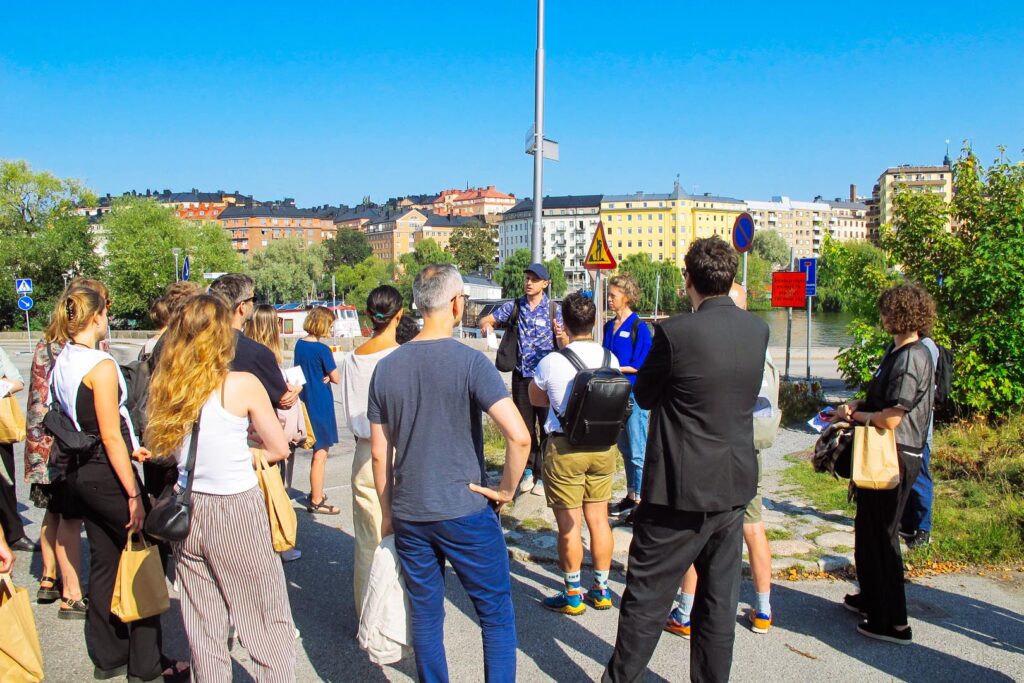
Learning Landscapes
Every space is a potential learning landscape—a site of latent knowledge and experience, of encounter and interaction, agency and entanglement. A child knows this, and learns about the world through interaction and engagement with the environment-world around them, climbing trees, collecting stones and autumn leaves, building shelters of sticks, and hopping over cracks on the pavement. This process doesn’t stop with adulthood, but often becomes backgrounded, a kind of second nature we don’t think about—we often move through the world with seriousness and purpose, unconsciously taking clues from the everyday spaces around us as we go about our everyday lives, commuting from home to work, maybe picking up the kids from school or preschool, going to the supermarket, or the gym. We learn from the landscape intuitively as we move through it, and inhabit it, through repetition and over time, from the places and people we encounter. But do we still see the world with the sense of wonder, curiosity, attentiveness, and playfulness as a child does? And how can we see and learn about what kind of past societal ideals and present negotiations are part of shaping the everyday spaces we live in? Anthropologist Anna Tsing suggests that “To learn anything we must revitalize arts of noticing,” paying attention to the fine grain of the world in order to see and understand the bigger picture, and how things interact and relate. To see every space as a learning landscape we propose practicing the “arts of noticing” and paying attention to the things and people that normally remain hidden in the background. The learning landscapes of Liljeholmen encompass a broad category of spaces that include playgrounds, schoolyards, parks, office blocks, industrial sites, residential neighbourhoods and shopping malls, as well as more informal and undefined spaces such as forests, unbuilt lots, and other urban leftovers. We ask how these spaces have come about, how are they used, and what can they teach us? Walking together through the landscapes of Liljeholmen we aim to collect impressions of everyday space and everyday life—of what is actually happening on the ground—and initiate a collective conversation about the city from our differing perspectives, experiences and research practices.
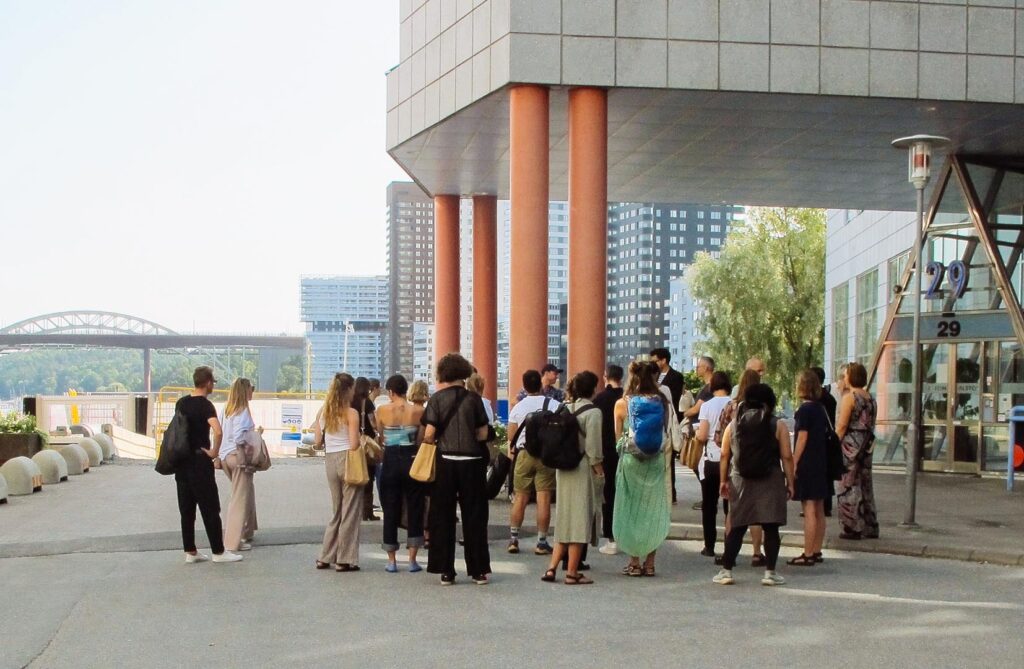
Reading the City
The city is a palimpsest—a mess of entangled layers and multiple, conflicting, simultaneous narratives, and as such can be read in an infinite number of ways. Reading the city with the grain there are grand narratives and official histories, while against the grain one will find counter-narratives, minor histories, and forgotten and overlooked voices. Cities are sites of constant negotiation, concerning political, social, economic, cultural, and environmental issues, such as how should land be best used, by who, for what purpose, and for whose benefit? What kind of life is generated between buildings, who is visible in public space, when, and doing what activities? This walk will cut a transect through Liljeholm, starting at the former industrial landscape surrounding Färgfabriken, moving through various historical, social, material, and ecological layers of urban space, before finishing on a hill offering another perspective over the city we just passed through. The walk intends to learn from Liljeholmen, to approach Liljeholmen as a learning landscape that has the potential to teach us something about the city and its social, political and urban processes—Stockholm in particular, but knowledge gleaned from the walk should hopefully provide insight into issues and processes occurring in other places. Liljeholmen is a particularly interesting site of study, as it occupies a liminal position between the inner historic core of Stockholm and the surrounding suburbs. Developed as one of the earlier industrial suburbs of Stockholm in the mid-eighteenth century, Liljeholmen soon grew into a messy cluster of hard, dirty, and dangerous industries and haphazard housing for the expanding population of workers and their families. Today not much industry is left, with the exception of the cement silos (which are soon planned to be relocated), and the area has been transformed into a node for living, commerce, consumption, and recreation.
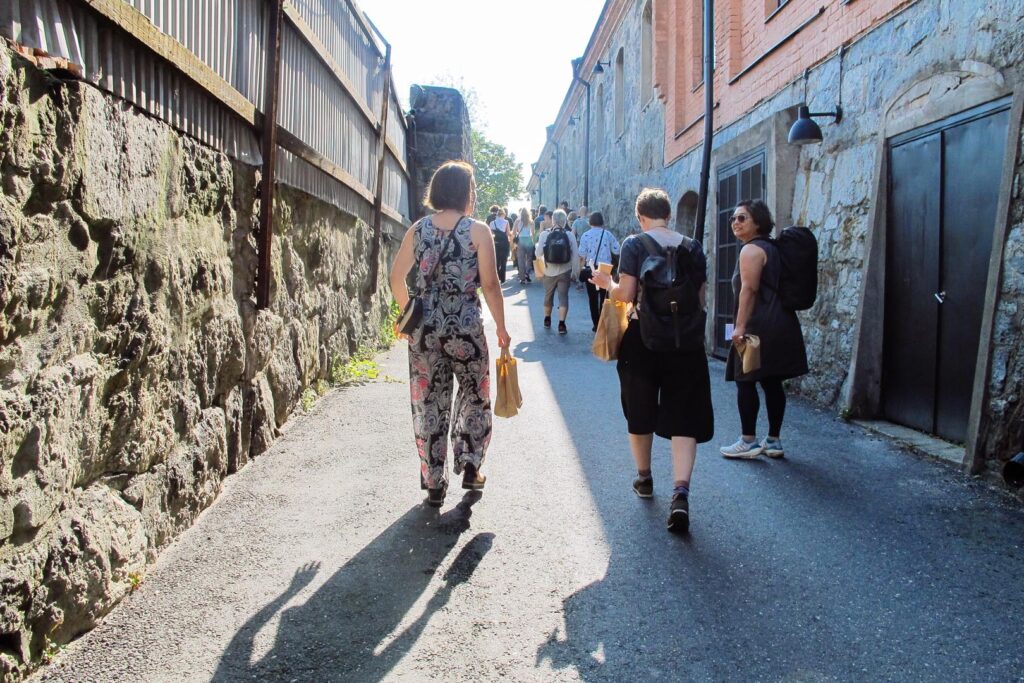
Walking as a Method
Walking is a means of learning with the environment, of gleaning knowledge and experience from interaction, observation, and experimentation with the world. It is a practice that engages the full sensory capacity of the body — sight, sound, smell and touch — in constant contact with the ground, and as such has the potential to shift the architectural gaze away from the disembodied “god’s eye view” from above towards a more partial and embedded perspective. Not that this detached view is inherently bad—as architects, planners, and researchers we all rely on maps, plans and abstract representations of space—but walking as a method is a way of grounding what we do in lived experience and lived space.
For us living in Stockholm, walking is often a part of everyday life, and as such something quite ordinary and mundane, but walking as a practice can also be employed as a particular method of research-creation. Here we build on the practice and writings of other walkers who have gone before us, and developed their own idiosyncratic walking methodologies. The Italian collective Stalker (composed of former students of architecture) set out to explore and map the in-between, abandoned urban voids of Rome in the 1990s, crafting a collective practice of walking which attempted to grasp the unconscious of the city. Lucius Burckhardt developed a pedagogical method of walking he termed “Strollology” to encourage students to closely observe urban space and life. More recently Stephanie Springgay & Sarah E. Truman of WalkingLab have explored the theory and practice of critical walking methodologies through interdisciplinary arts practices and public walking events, drawing on feminist-queer, anti-racist, anti-ableist, and anti-colonial thought to question who gets to walk where, how we walk, under whose terms, and what kind of publics we can make.
Walking together in Liljeholmen, discussing what we observe and paying a specific attention to the surroundings, the method has brought about an embodied sense of learning about the city, and how we can situate our research on that ground. For me (Matilde) walking as a method brings about a possibility to ground the spatial analyses, to experience the everyday places I map on the computer screen in a more embodied sense, moving from maps to the territory. For me (Matthew) walking as a method is a way of exploring topics such as extraction, material flows, and large scale territorial transformations beyond the abstract, and understanding the effects these processes actually have on the ground.
This walk is a starting point from the ground, for a collective conversation, an experiment, to see where it can take the research-thinking further on.
Matilde Kautsky is an architect, educator, and PhD candidate at KTH School of Architecture in Stockholm. Her research explores how societal changes are materialised in the architecture of everyday spaces, as revealed through document studies and spatial analysis of public school yards in Stockholm . She also teaches in the master’s program Sustainable Urban Planning and Design.