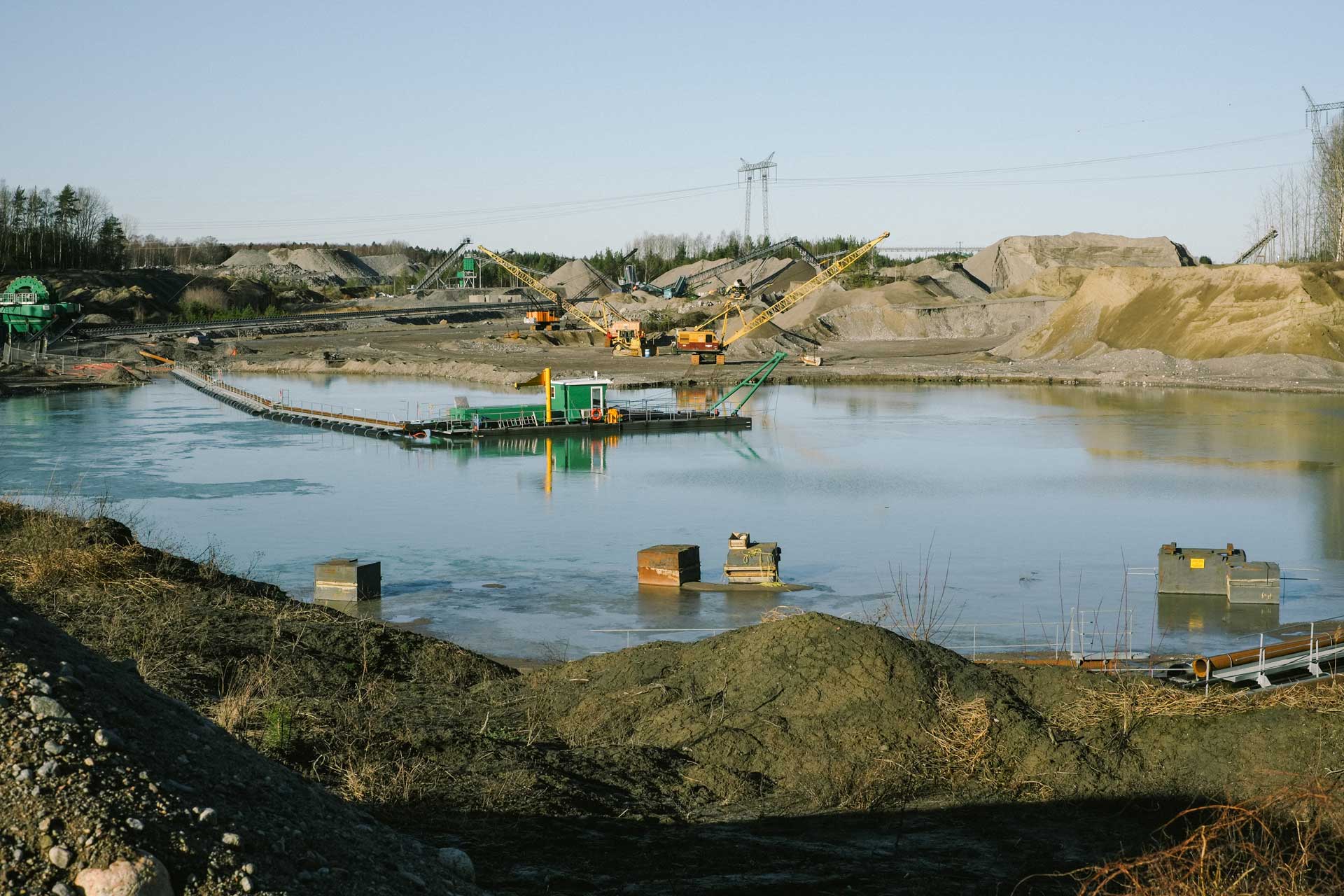
Groundbreaking: Fieldnotes from Forty Walks
Across Stockholm’s Landscapes of Extraction
PhD dissertation, RMIT University Melbourne, 2025
Introduction: The Story is in the Earth
The Marrow
There was a word inside a stone.
I tried to pry it clear,
mallet and chisel, pick and gad,
until the stone was dropping blood,
but still I could not hear
the word the stone had said.I threw it down beside the road
among a thousand stones
and as I turned away it cried
the word aloud within my ear
and the marrow of my bones
heard, and replied.Ursula Le Guin, “The Marrow.”
Ursula Le Guin, “The Marrow” in Hard Words (New York: Harper and Row, 1981).
Breaking Ground
There’s a stone beside a road southwest of Stockholm. It rests upon a small hill, nestled amongst a small grove of pines. The lingering remains of a forest recently reduced to a landscape of mutilated stumps and disjointed branches, harvested and put-to-use elsewhere, as lumber, paper, packaging, biofuel, and firewood. Yet the stone perdures, occupying more-or-less the same position it’s stood for a thousand years.[1] Brötastenen (The Bröta Stone), named after a nearby village, is a Viking era runestone located close to the municipal boundaries of Botkyrka and Nynäshamn, in the historic province of Södermanland (fig. 1). Upon its lichen-encrusted surface are etched the figures of a snake and a Christian cross, as well as an inscription in runic script which reads,
Vigmar raised this stone in memory of Jörunde, his kinsman, companion, and brother.[2]
The word bröta is derived from the Old Norse word for road, braut, which is related to the modern Swedish verb bryta, “to break,” as in bryta väg, “to break a path, or make a road.”[3] The village, taking its name from the act of roadmaking, is situated along the ancient route between Södertälje and Sorunda, at a point where the road cuts into the once treacherous Hanveden Forest.[4] For most of its existence the road was nothing more than a drovers track, utilized by locals to transport produce and livestock between neighbouring properties, and the occasional traveling merchant. These slow pastoral rhythms of life changed dramatically in the late nineteenth century with the arrival of the railway line to Tumba, which orchestrated a spatial and temporal shift as surrounding villages were thrown into the economic reach of markets in Stockholm. The road through Bröta suddenly saw a dramatic increase in traffic as local farmers rushed to sell their produce—particularly dairy goods—at higher prices in the city. To keep traffic flowing, and goods circulating, the road was widened, and its unpaved surface maintained with sand and gravel quarried from the fluvio-glacial reserves of the underlying esker.
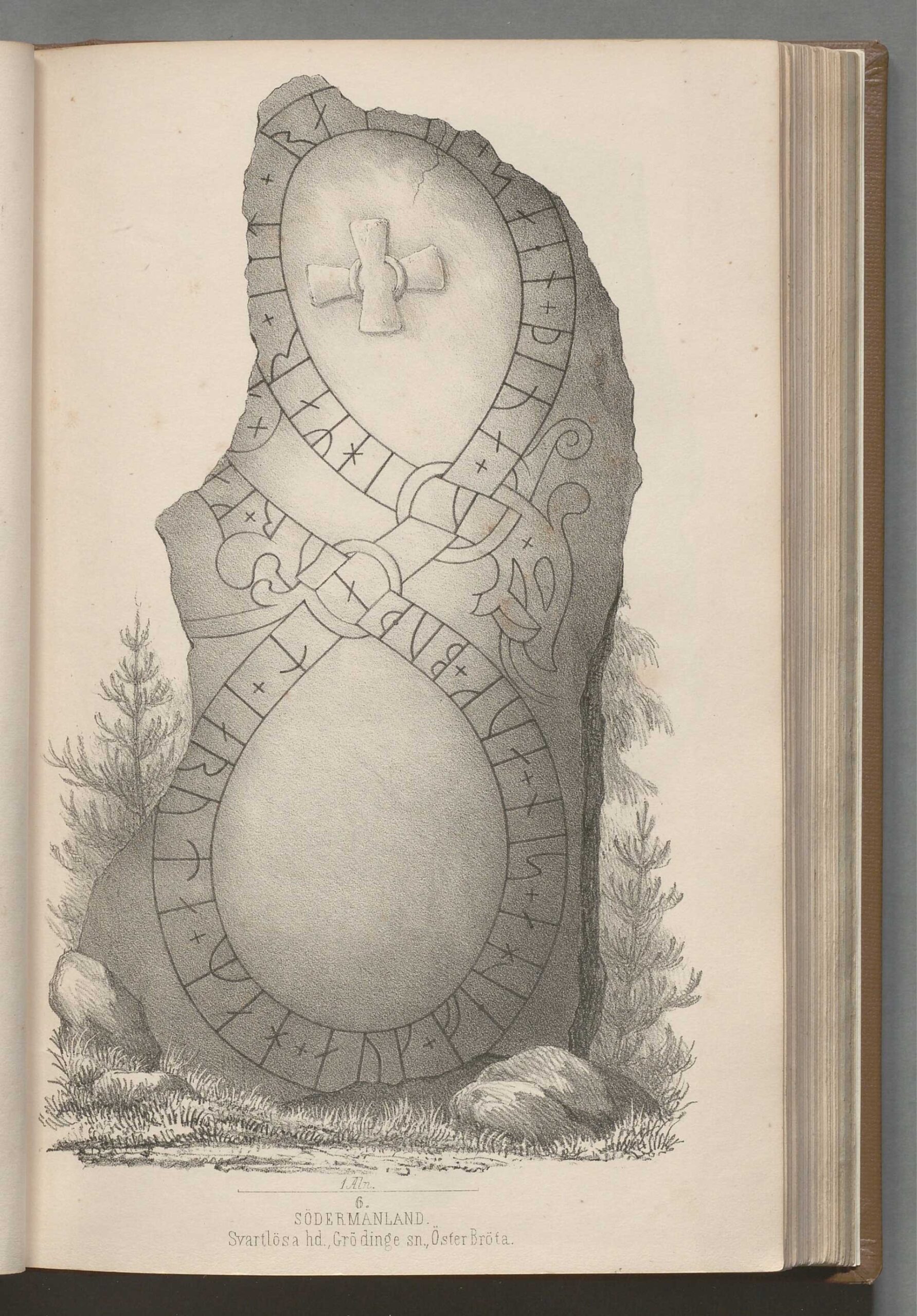
Fig 1. Rune stone (Sö 292) in Bröta, Botkyrka, also known as Brötastenen. Richard Dybeck, Svenska run-urkunder (Stockholm: J. L. Brudin, 1855), 117. Scanned image from the collections of Kungliga biblioteket (Arkeol. Runol. Ex. A).
Breaking ground and taking ground are the primordial acts of construction. All buildings appropriate a patch of earth, and the act of building is dependent upon taking matter from the ground—sand, stone, limestone, iron ore, clay, bauxite, gypsum, petrochemically derived plastics, as well as organic matter such as timber and fibres. While the English word quarry has its origins in Latin, derived from quadrat, meaning “square,” or “to square stones,” the Swedish equivalent of brott (often preceded by the word stone, as in stenbrott) is derived from the same root as bröta—the act of breaking. Sand and gravel pits however are usually referred to as a täkt or tag, an older Swedish form of the verb “to take.” Earth is broken, and earth is taken. Materials are quarried, extracted, mined, harvested, transported, processed, combined, and rearranged to produce the various structures and infrastructures that constitute our everyday urban environments.
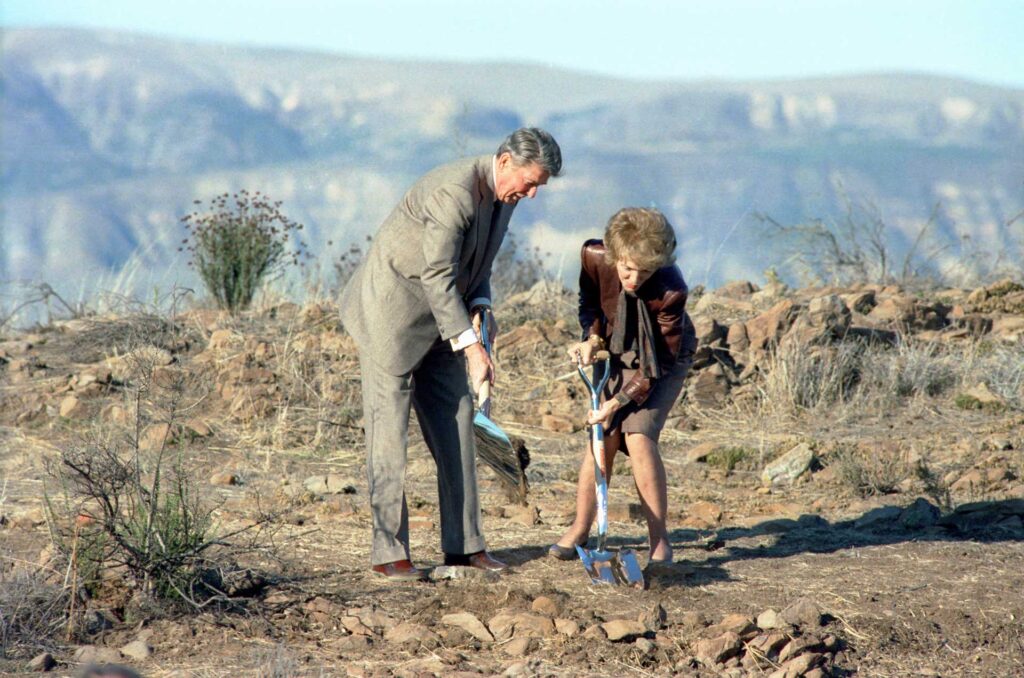
“Breaking ground” is often considered the first act of construction, with the history of groundbreaking ceremonies stretching back into antiquity. The first documented ceremony took place in China in 113 BC, although similar rituals likely occurred much earlier.[5] Historically groundbreaking ceremonies would precede the construction of religious and symbolic structures, consecrating the ground upon which the intended building would eventually stand. These rituals were accompanied with offerings of fruit, wine, grain, or tea leaves, in order to appease the relevant gods and deities, safeguard a smooth construction process, and ensue a prosperous life for the building and its future inhabitants. Today groundbreaking ceremonies are no longer restricted to the sacred, representing a common ritual used to celebrate the start of any profane new development. Politicians in suits, business heads, builders, developers, and architects, pose for photographers with ornamental shovels, symbolically “breaking the earth” and signifying the commencement of construction (fig. 2). The old gods are snubbed, but there are new deities that must satisfied—shareholders, boards of directors, political egos, finicky financial markets, and wavering pubic opinions.
Once the stage is empty, the crowd dispersed, and the marque packed up, the real work begins. Bulldozers, excavators, and piling machines move in and start breaking the ground in earnest—dislodged earth deemed waste is hauled offsite to be disposed of, while other forms of displaced matter is trucked in to support the emerging building’s foundations. As Robert Smithson once wrote,
With such equipment construction takes on the look of destruction…. Building takes on a singular wildness as loaders scoop and drag soil all over the place. Excavations form shapeless mounds of debris, miniature landslides of dust, mud, sand and gravel. Dump trucks spill soil into an infinity of heaps.[6]
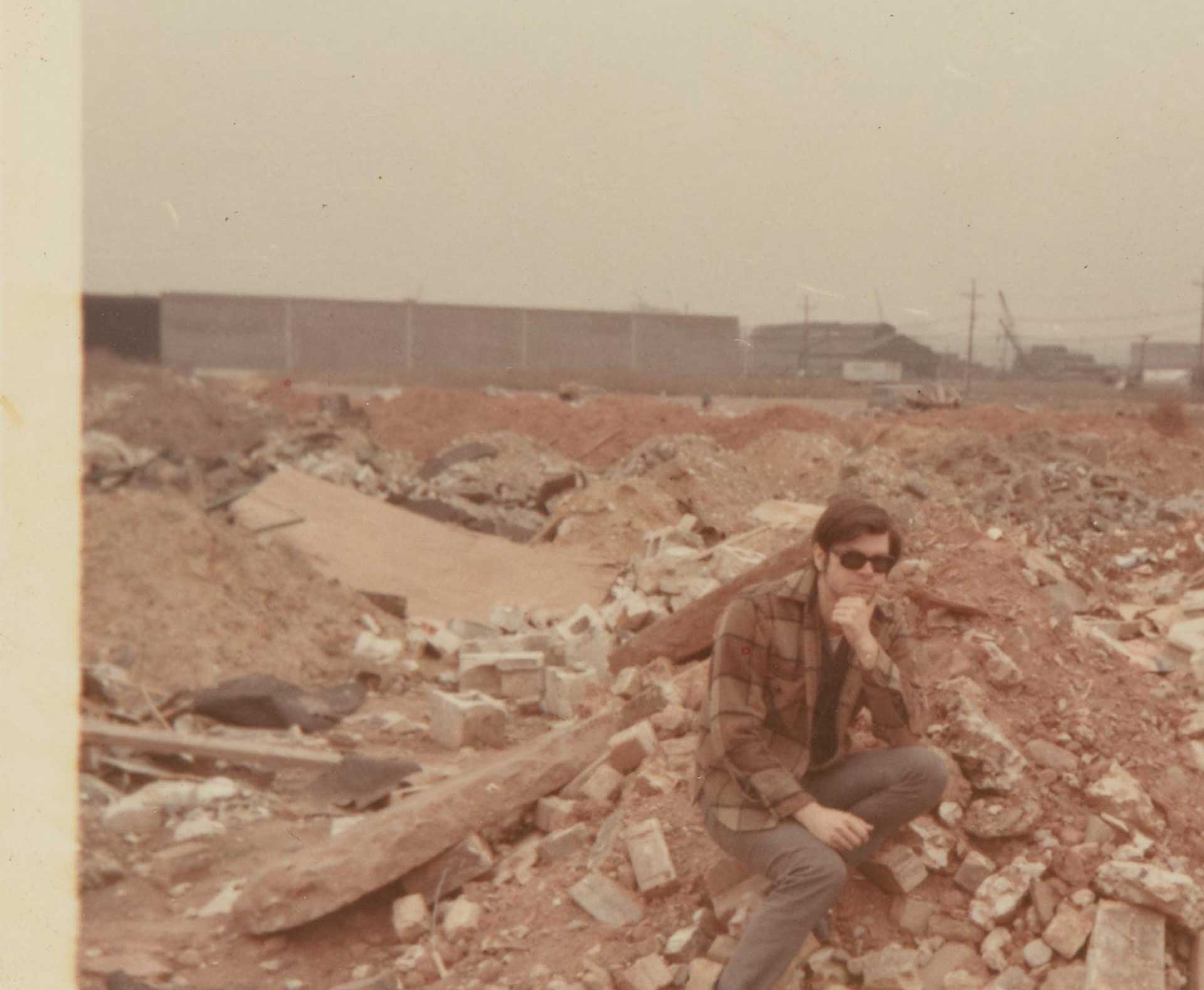
Every act of construction is intertwined with multiple acts of destruction, unfolding at various spatial and temporal scales. A site can no longer be understood as a tabula rasa—as a blank slate awaiting the plans of the architect or builder—but always constitutes a complex assemblage of existing realties and relations. Even the most mundane suburban plot is a jumble of historical, cultural, material, social, and ecological entanglements. Beyond the immediate local impact of construction—of displacing an existing reality and replacing it with another—are other forms of ruin, spread out across time and space, from the atmospheric release of carbon emissions, to the slow seepage of toxins into the groundwater, and the distant sites of devastation produced through resource extraction. The groundbreaking of a new project presupposes the breaking of ground elsewhere. Such “relations of destruction” were a constant theme in Smithson’s work, exemplified in his Non-Site projects, where geologic material collected from distant mines, quarries, and other industrial sites, accompanied by a collection of maps and photographs, were exhibited in gallery spaces. To Smithson these “Non-Sites” depicted a kind of three-dimensional map engaged in a dialectical relationship with the actual site, where the material put on display exists as a “fragment of a greater fragmentation.”[7] The displaced matter in the gallery was more than an object-in-itself, but opened up a space for thinking about the peripheral landscape of displaced earth—of seeing material as entangled within processes of ongoing relationships (fig.3).
Landscape architect Jane Hutton, taking inspiration from Smithson’s artistic practice, employs the term “reciprocal landscapes” to define the dialectic relationship between building materials and their wider social, ecological, and territorial entanglements. “Reciprocal landscapes,” Hutton writes, stem from “a desire to think of construction materials not as fixed commodities or inert products, but as continuous with the landscapes they come from, and with the people that shape them.”[8] Materials move, disperse, transform, aggregate, and recombine, as they circulate throughout ecologies of utility, between sites of origin and their intended use within architectural and infrastructural projects. As Hutton writes, thinking in terms of reciprocal landscapes allow us to “Think of all of the landscapes a material passes through or is physically contiguous with, the different forms it takes, and the people it interacts with along the way.”[9] The act of tracing material movements backwards at some point eventually leads back to the earth—the load of aggregates in the lorry waiting to be combined with water, cement, and steel to form the foundation of a new building is not some abstract commodity, but matter displaced from a particular place. Fragments of a fragmented landscape.
Groundbreaking: Fieldnotes from Forty Walks Across Stockholm’s Landscapes of Extraction takes “breaking ground” as a lens from which to explore the dialectical relationship between acts of building and its wider territorial consequences, opening up a space for thinking about processes, building materials, sites, and landscapes commonly relegated to the background of our gaze. I use the term acts of building to define architecture and construction in a broad sense, encompassing multiple scales of man-made alterations to the environment, ranging from single-detached houses through to large scale infrastructural works, and urban scale interventions. Following the flows of broken earth—the mundane materials of sand, gravel, crushed rock, and excavation waste—the dissertation embarks on an intrepid exploration of the multiple “landscapes of extraction” that permeate the hinterlands of Stockholm. The act of “following” becomes a thread which weaves its way through the entire PhD, pursued on the ground in the form of a creative walking practice, which traces the spatial and temporal movements of material. Walking becomes a means of entering the landscapes, perceiving enduring processes of transformations, and becoming attuned to entangled social, material, and ecological relations. The project sets out to observe, record, and disseminate what is actually happening on the ground, in the mud and fine-grain of the world, asking what we can learn from “paying attention” to material flows and landscapes of extraction, when situated amongst them, from somewhere in particular?
[1] In 1854 the rune stone was repositioned upright after falling over, and in 1911 the stone was moved several meters to its current position, as the road was realigned, cutting into the esker.
[2] Translated from Swedish: “Vigmar lät resa denna sten efter Jörunde, sin frände och kamrat…broder…” Runinskrift Sö 292 i 2020 års utgåva av Samnordisk runtextdatabas, Institutionen för nordiska språk, Uppsala universitet.
[3] This information was gleaned from the information plaque beside the stone: “Det kan påpekas att platsens namn, Bröta, innehåller det gamla ordet för väg braut. Ordet braut är till sin betydelse besläktat med verbet bryta, i detta sammanhang ‘bryta väg.’”
[4] For more information about the Bröta Stone and its history, see; Elias Wesén and Erik Brate, Eds., Södermanlands Runinskrifter (Uppsala: Almqvist Wiksell, 1936), 264–266. Available as a pdf at https://www.raa.se/runinskrifter/sri_sodermanland_b03_h04_text_2b.pdf
[5] 113 BC was quoted on Wikipedia as the year of the first documented groundbreaking ceremony, but this fact was sourced from the homepage of Perlo Construction, operating out of Portland, Oregon, so the veracity of the claim is unverified. The origins of groundbreaking ceremonies however stretch back deep in history, across various cultures. This is an interesting topic that warrants further study.
[6] Robert Smithson, “A Sedimentation of the Mind: Earth Projects,” Art Forum, September 1968, republished in Robert Smithson: The Collected Writings, ed. Jack Flam (Berkeley: University of California Press, 1996), 128.
[7] Smithson, “A Sedimentation of the Mind,” 111.
[8] Jane Hutton, Reciprocal Landscapes: Stories in Material Movement (New York: Routledge, 2020), 24.
[9] Hutton, Reciprocal Landscapes, 26.
To download the full dissertation click on the link below