Ghost Walk: Walking the Spectral
Landscapes of Energy Pasts, and Futures
Walking Workshop held at the symposium “Futures Beyond ‘Transition‘: Perspectives from the Energy Humanities” Centre of Excellence for Anthropocene History, KTH, Stockholm, 13-14 November 2025
“Ghosts remind us that we live in an impossible present—a
time of rupture, a world haunted with the threat of
extinction. Deep histories tumble in unruly graves that are
bulldozed into gardens of Progress.”
Anna Tsing, Heather Swanson, Elaine Gan, and Nils Bubandt
November in Stockholm. It’s cold, wet, and inescapably dark. The colourful autumn leaves of October have fallen and dispersed, leaving behind only skeletal trunks. The season of fertility and abundance is over, and nature begins to transition into its annual winter survival mode. We humans too, living in these northern latitudes, tend to drift towards a low-energy state of existence, adapting to—or simply enduring—the protracted solar deficit. It’s not always the most pleasant time of year to take a walk, but the grey skies and subdued light offer a fitting mood for reflection and contemplation. An opportunity to think together about futures beyond transition.
The word “transition” comes to us from the Latin, Transitio, which refers to “a passage” or “a crossing over.” It could refer to a spatial crossing between two places (as in transit), a temporal passage between different moments in time, or else a change from one state of existence to another. So it’s fitting that we will explore the concept of transition on our own spatial crossing through the energy landscapes of Stockholm, moving through different geographies, temporalities, and states of energy and matter. And during this dark time of year— recently celebrating Halloween and Allhelgonadagen—the figure of the ghost emerges as apt guide to help as navigate, understand, and narrate this liminal state of transition.
Ghosts reveal the multiple entangled pasts embedded in the landscape, and although their uninvited presence is unsettling, in recalling other histories, they can also allow us to see the present more clearly. Ghosts occupy the transitional zone between life and death, between the past and present, and between form and formlessness, and as Hélène Cixous reminds us, “It is the between that is tainted with strangeness.”[1] As a figure of the between, the ghost embodies a transitional state, or as Martin Hägglund writes, “What is important about the figure of the specter, then, is that it cannot be fully present: it has no being in itself but marks a relation to what is no longer or not yet”[2] In thinking about—and with—energy landscapes, past and future, this spectral no longer or not yet could be a helpful way of understanding the current moment of the eternal “status quo,” where fossil ghosts refuse to die, yet the promise of a clean energy future remains a kind of mirage on the horizon. Energy landscapes, fossil and otherwise, also occupy uneven geographies, often rendered invisible to the final consumer, yet ghosts have the capacity to rupture these spatial dislocations, making the far away present.
Walking the energy landscapes of Stockholm on a bleak afternoon in November, the “ghost stories” we encounter will help us to collectively think, reflect, unpack, and speculate upon the multiple temporal, spatial, and material entanglements of the so-called energy transition, and hopefully open up a line of thought beyond the current status quo.
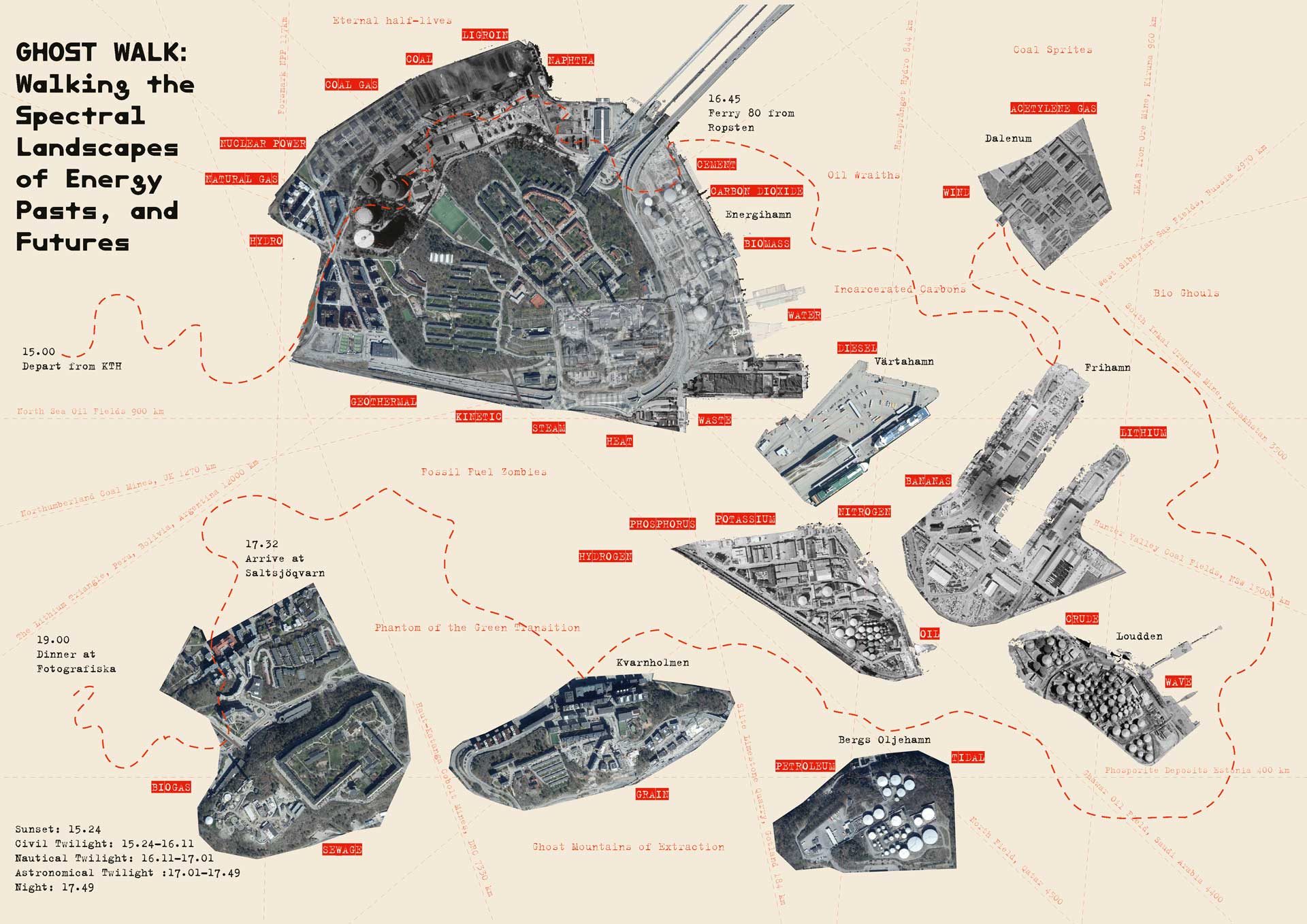
The walk itself will depart from the Centre for Anthropocene History at KTH, cut through the Royal National Park of Djurgården, and then continue through the relatively new urban development of Norra Djurgården, built upon the site of the former Värta Gasworks. We will then walk to the industrial harbour of Energihamnen, where we will continue our journey by sea, taking a commuter ferry towards Södermalm. The boat trip will take approximately 40 minutes, and should allow us plenty of time for reflections, discussions, and speculations, concerning the energy ghosts of the landscape around us.
The Map can help us think with, and through different forms of energy and matter, and the relationship between Stockholm and “reciprocal landscapes” of energy production and extraction, both past and present. Traces, ghosts, pulses, and flows which move across the city. Maybe we could use this time on the boat to craft and narrate some of our own “ghost stories” of energy pasts, and futures. Please feel free to add further notes and annotations to the map, or write other thoughts, stories, anecdotes, or pieces of poetry in the blank space provided here.
[1] Hélène Cixous, “Fiction and Its Phantoms: A Reading of Freud’s Das Unheimliche (The ’Uncanny ’),” in Volleys of Humanity: Essays 1972–2009, ed., Eric Prenowitz (Edinburgh: Edinburgh University Press, 2011), 543.
[2] Martin Hägglund, Radical Atheism: Derrida and the Time of Life, Stanford University Press, 2008, 82.