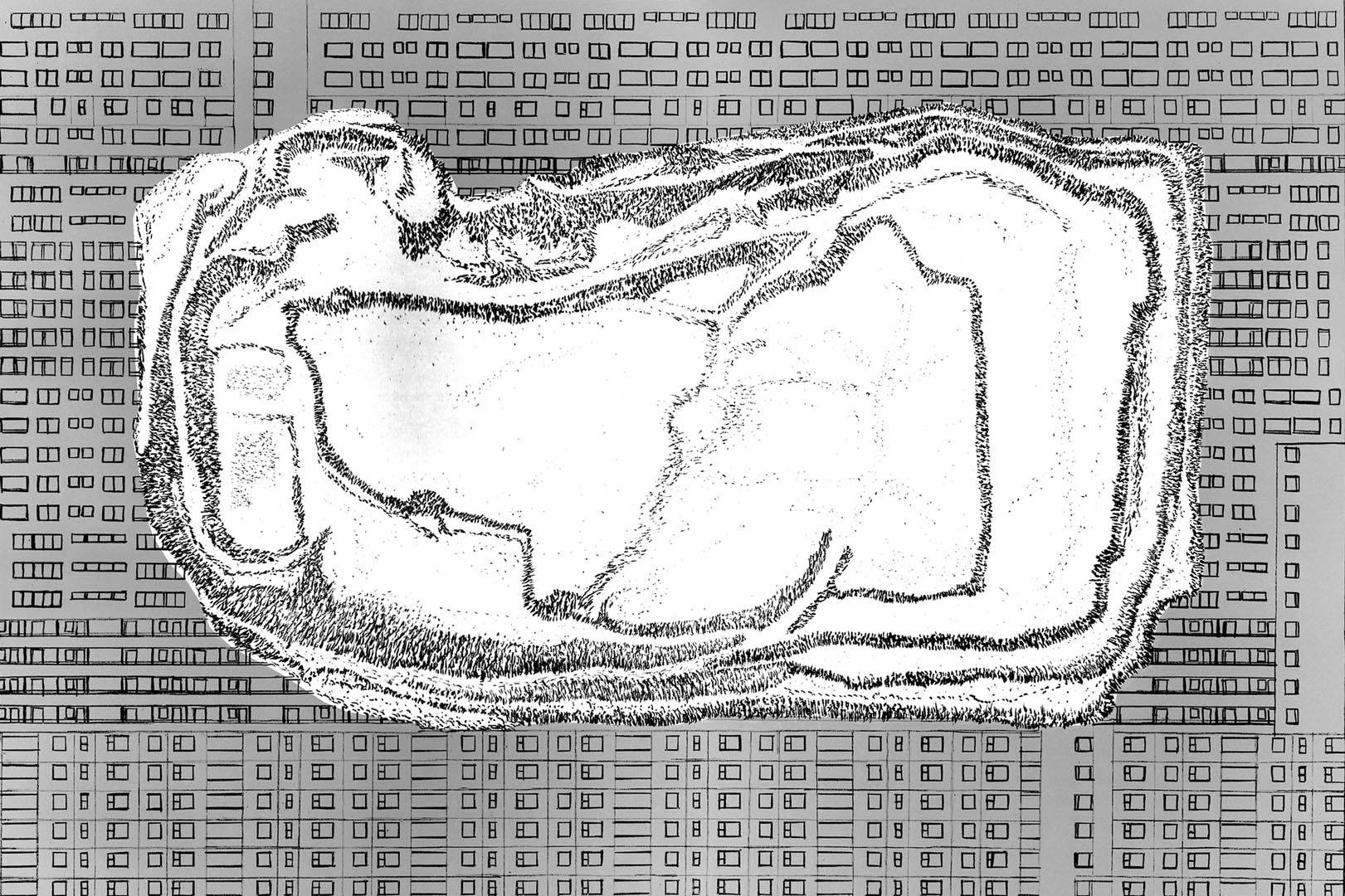
Postcards from the Anthropocene
In PAPER, Issue #18, July 2015.
According to Walter Benjamin, we can already envision the utopia to come because it has left its traces in the now, in “thousands of configurations of life, from permanent buildings to fleeting fashions.”[1]
A journey traversing the periphery of Malmö is a passage through these fragmented traces of utopia, past fields of wheat and barley, neo-medieval gated communities, distribution warehouses, outlet stores, shopping malls, conference centres, sports arenas, office towers and the greying social housing estates of the welfare state. It is a landscape in perpetual transition, like the shifting sands on a beach, altered continuously by the mechanisms of speculation and the processes of late capitalist liquid modernity. A place of flows where everything and everyone is on the move, be it the elites of the creative class or migrants fleeing war and persecution. Yet despite this constant motion it is also a place stuck firmly in the eternal present. The past has been thoroughly erased and there is only one future on offer—the status quo.
There may, however still be hope of finding traces of an alternative future hidden among these glimmering ruins of the present. Between the ever-expanding neoliberal city and the infrastructural apparatus of the Öresund bridge lies a potential space of resistance in the massive exhausted landscape of a former limestone quarry. This immense void, covering over 100 hectares, is the consequence of 130 years of industrial exploitation. What was once a loud, dusty site of production and resource extraction is now an eerily tranquil place—an uncanny inverted island hidden just below the surface of the city—a landscape which could be equally contemplated as a remnant from a distant prehistoric past, or a glimpse into a post-apocalyptic future.
If we believe cities to be one of humanities greatest achievements, then sites such as the quarry could be considered as their original moulds. They are the negative spaces from which our urban environments where cast. A monumental archive recording over a century of urban development and real estate speculation, where it is not only the physical scar in the earth which speaks, but equally the ghostly mass of absent material. Limestone which was crushed, processed and burnt to create cement, later mixed with sand and gravel to produce concrete, which was then combined with steel to built our modern cities. A journey into the quarry site is one which traces the history of the modern Swedish construction industry—an indirect interrogation of the contemporary city via way of a detour into the depths of a site of its actual material production.
Limestone has been quarried from the land south of Malmö since medieval times, with its significance even reflected in the areas name—Limhamn translates to ‘Lime Harbour’. The limestone was burnt in rudimentary kilns to produce lime paste which was then mixed with sand and water to make mortar which was used by local builders. In the sixteenth century the site gained the attention of the Danish Crown which was undergoing a building boom and needed a reliable source of material for its castles and fortifications. The limestone operation was granted to a group of Dutch entrepreneurs who were tasked with ramping up production to satisfy the Crown’s needs. The quarry continued to supply the royal Danish construction industry until 1658 when Denmark was forced to cede the region of Skåne to Sweden in accordance with the treaty of Roskilde.[2] The kilns were repeatedly destroyed during the years of war that followed, and it wasn’t until the mid eighteenth century that a stable quarrying operation was re-established.
The modern history of the Limestone quarry can be traced back to 1866, when fifty smaller limestone pits where consolidated into one large operation; the present quarry site. The re-invention of cement in both Great Britain and France around this time lead to a great interest in the potential of this new material, and in 1871 Skånska Cement AB was founded, taking over operation of the quarrying operation as well as building Sweden’s first Portland cement factory. As Cement production began to increase toward the end of the century so too did the demand for Hydraulic lime (calcium oxide), which is the main component of Portland cement, producing the chemical reaction causing it to set. The quarrying operation expanded rapidly, utilising modern industrial techniques such as steam powered machinery and dynamite to increase production and laying a vast network of railway to speed up the transportation of material between the site and the cement factory. In 1887 Skånska Cementgjuteriet was founded as a small subsidiary company to produce concrete products. This company would go on to become Skanska—Swedens largest construction company and today a major player in the global construction industry.
The Swedish appetite for cement slowly increased during first few decades of the twentieth century, but it wasn’t until after the Second World War that demand really became insatiable. Although Sweden avoided the scale of destruction experienced by most European countries during the war by maintaining a (at times questionable) stance of neutrality, it was nonetheless keen to (re)build for the modern society, and this project required lots of concrete. It is interesting to contemplate the choice of concrete as the preferred building material given 70% of Sweden’s surface area is covered in forest – was concrete seen as more modern? Was it more suited to the politics of the ruling social democratic party, as an industrially produced material with strong associations to the workers movement? Or was it simply a masterstroke by former Swedish social democratic Prime Minister Per Albin Hansson (1932–1946), architect of the Swedish welfare state (Folkhemmet) as a way of concentrating the construction industry in his home town of Malmö? There were certainly many reasons to prioritise concrete as the preferred building material of the modern Swedish welfare state (Adrian Forty’s book “the culture of concrete’ provides a thorough reflection on the place of concrete within modernity) but the decision certainly had implications on the ground in Limhamn where cement production was rapidly ramped up and industrial processes rationalised, creating a formidable construction machine able to remove raw limestone at one end and pump out prefabricated housing units at the other. This optimised system of production and construction was already well developed by the time the Million Homes Program was enacted by the Social Democratic government in 1965, and certainly contributed to its success.[3]
The oil crisis of 1976 and the subsequent heavy slump in the building industry should have come as a massive hang over to the cement industry after the good times of the decade before, but they were already looking to the horizon and the next moneymaker – real estate. Euroc, the new incarnation of the cement company Cementa (Previously called Skånska Cement AB) owned a vast amount of land to the south of Malmö encompassing the quarry site, cement factory, harbour and a large stretch of coastline, which it had bought for next to nothing in the mid 1800s. The heavy downturn in the economy led to huge job losses in the city, decimating the shipyards and textile industries, but the Euroc concern were more optimistic, building a decadent new corporate headquarters just to the north of the quarry, designed by renowned local architect Sten Samuelson. Politicians were searching for a solution to the city’s woes and Euroc had the answer – The Öresund bridge. The idea of a bridge between Denmark and Sweden had been floated many times before with a very detailed proposal drawn up in 1936, but the crisis of the 1970s and 1980s provided the right political climate for the project to finally gain support. The company sold a portion of its land to the government for the road and rail corridor, won the lucrative contract to provide cement for the project and gained development rights (worth several billion SEK) to build on their remaining land around the quarry, which was subsequently decommissioned in 1994, just before construction of the bridge was due to commence.
Today the former Euroc corporate headquarters has been transformed into a luxury residential complex called Victoria Park; the first gated community in Sweden. It sounds completely absurd that a suburban office building on the edge of a dirty, noisy quarry would one day become an exclusive apartment complex marketed for its ‘urban lifestyle’ and ‘unique natural environment’, but it’s a transformation that was seemingly anticipated by the cement company. A smooth transition from industrial modernism to late capitalism (or postmodernism)—“All that is solid melts into air”—or as Mark Fisher has recently put it, “All that is solid melts into PR.”[4] Victoria Park is not alone, and there is a steadily expanding ensemble of new development creeping up around the rim of the quarry, with alluring names such as “Grand Canyon”, “The Coral” and “The Chalk House”. The cement company actually had much grander ambitions for the site originally, proposing to build a visionary new city centered around the former quarry, which would have been inundated with water to become a lake. The visions came within a whisker of becoming reality, but the grand plans were halted by the newly elected social democratic government of 1994 which intended instead to revitalise the former dockyards. After considering every conceivable use for the quarry site, including a golf course, theme park, shopping centre and motocross racetrack, the cement company decided instead to ‘donate’ the land to the Municipality to be preserved as a nature reserve, in return for increased development rights on their remaining land. You win some, you lose some.
Pablo Picasso once famously stated that “every act of creation is first an act of destruction.” The quarry could be considered to be the collective accumulation of destruction required for the production of a certain amount of urban space, as could other places of material extraction, usually situated on the periphery of our perception, and concealed from our daily lives. The large monocultural pine plantations spread throughout Sweden supply us with our timber and the massive open cut iron ore mine of Kiruna with our steel. The effects of the construction industry are not limited to our urban environments, but permeate across the landscape leaving deep, lasting scars in the earth. The rise of a collective environmental consciousness and a focus on sustainability has led to many significant improvements, but progress now seems stalled, with the rhetoric of sustainability so thoroughly integrated into the neoliberal system. We seem completely incapable of steering ourselves clear of inevitable ecological catastrophe, despite the green labels we stick to our products and our buildings.
A possible way beyond this impasse may be to consider the unavoidable processes of destruction inherent in the formation of our urban landscapes. To understand these manufactured and corrupted environments as pieces of architecture with their own distinctive design logic; the unintended result of human decisions. Donna Haraway would call these places cyborg landscapes, “a creature of machine and organism, a creature of social reality as well as a creature of fiction.”[5] This recognition that everywhere is in some way contaminated, manipulated and constructed by humans may break our naive conception that nature can still exist as a separate entity, and allow us to embrace the uncertain potential that a cyborg conception of space may offer.
Notes:
[1] Walter Benjamin, The Arcade Project (Cambridge: Belknip Press, 2002)
[2] An exceptionally cold winter in early 1658 allowed King X Gustav of Sweden to cross the Great Belt with his army to occupy the Island of Zealand, dealing Fredrick III of Denmark with a crushing blow and forcing him to sign the treaty of Roskilde, which ceded a third of the kingdoms territory to Sweden, including Scania (Skåne)
[3] The Million Program (Millionprogrammet) is the common name for the social housing policy implemented by the Swedish social democratic party in 1965, running until 1974. The program built over one million new homes in ten years.
[4] Mark Fischer, Capitalist Realism: Is there no Alternative? (Ropley: Zero books, 2009)
The original quote is from the communist manifesto by Karl Marx and Friedrich Engels – also essay by Marshall Berman (1982)
[5] Donna Haraway “A Cyborg Manifesto: Science, Technology, and Socialist-Feminism in the Late Twentieth Century”. Simians, Cyborgs and Women: The Reinvention of Nature. (New York: Routledge, 1991)