Fieldnotes from Riksten Quarry
In -ism Architecture Magazine, Issue 4, September 2022.
Location: Riksten
Date: 08.10.2020
Time: 9:17
Location: 59°09’N 17°55’E
Altitude: +80 m
Temperature: 12° C
Wind: S / 4 ms
Humidity: 94%
Cloud Coverage: Scattered
Precipitation: 0 mm
It started with a faint hum…
A sound barely audible above the low rumbles and growls of the machines meticulously dissecting the landscape. Its frequency however set it apart, occupying a distinct layer in the heavily saturated airspace. I assumed that it must have had its origins in the extractive operation below—a tormented scream released by the earth as it was devoured by metal teeth—yet it seemed to come from above. The hum soon intensified into an incessant buzz, like a mosquito entering a quiet room, amplifying an already heightened sense of anticipation. I had already crossed the threshold. Entered the zone—the forbidden domain. I was a trespasser. It was too late to turn back now.
Somewhat unnerved by the eerie noise, I hesitated by the southern edge of the abyss and reassessed my path of descent. Riksten quarry—one of the largest sources of aggregates and building materials in the Stockholm region—lay before me ready to be explored. Yet here I stood, motionless among the adolescent pines lining the rim of the inverted monument. The sound reached a crescendo. Something was approaching, looming. I look around, look up. Too late. It was now directly above me, and the stunted pines offered no place to hide. A drone. Its sleek white body scantly discernible against the cloudy autumn sky, its rotors lost in an angry blur. It paused, dwelling above me for a moment, meticulously observing me through its dark machine eyes. The red blinking light signaling that I was under surveillance. Someone, somewhere, was watching.
I stare back, immobilized by a combination of surprise and fright. Eventually, the drone loses interest, makes a U-turn, and disappears again out over the void of the quarry. The unanticipated encounter was unsettling. Who was operating this remote-controlled sensory device and for what purpose? Was it just another intrepid explorer like me, entering the zone by other means, or was it piloted by a high-tech security team employed by the mining company? As the hum of the drone fades into the distance, I hesitantly continue my descent down the scruffy slope. The respite is brief, however. Several minutes later the buzz returns, forcing me to seek refuge under the thorny branches of a small tree. The drone passes by overhead, once again turning around upon reaching the outer edge of the quarry. It seems to be following a predefined route, tracing an invisible grid from above, suggesting it wasn’t just a joy flight. As I edge deeper into the pit, the trees start to thin out, leaving me feeling rather exposed. The drone is on the return. Time to abort. I turn around and scramble back up the slope.
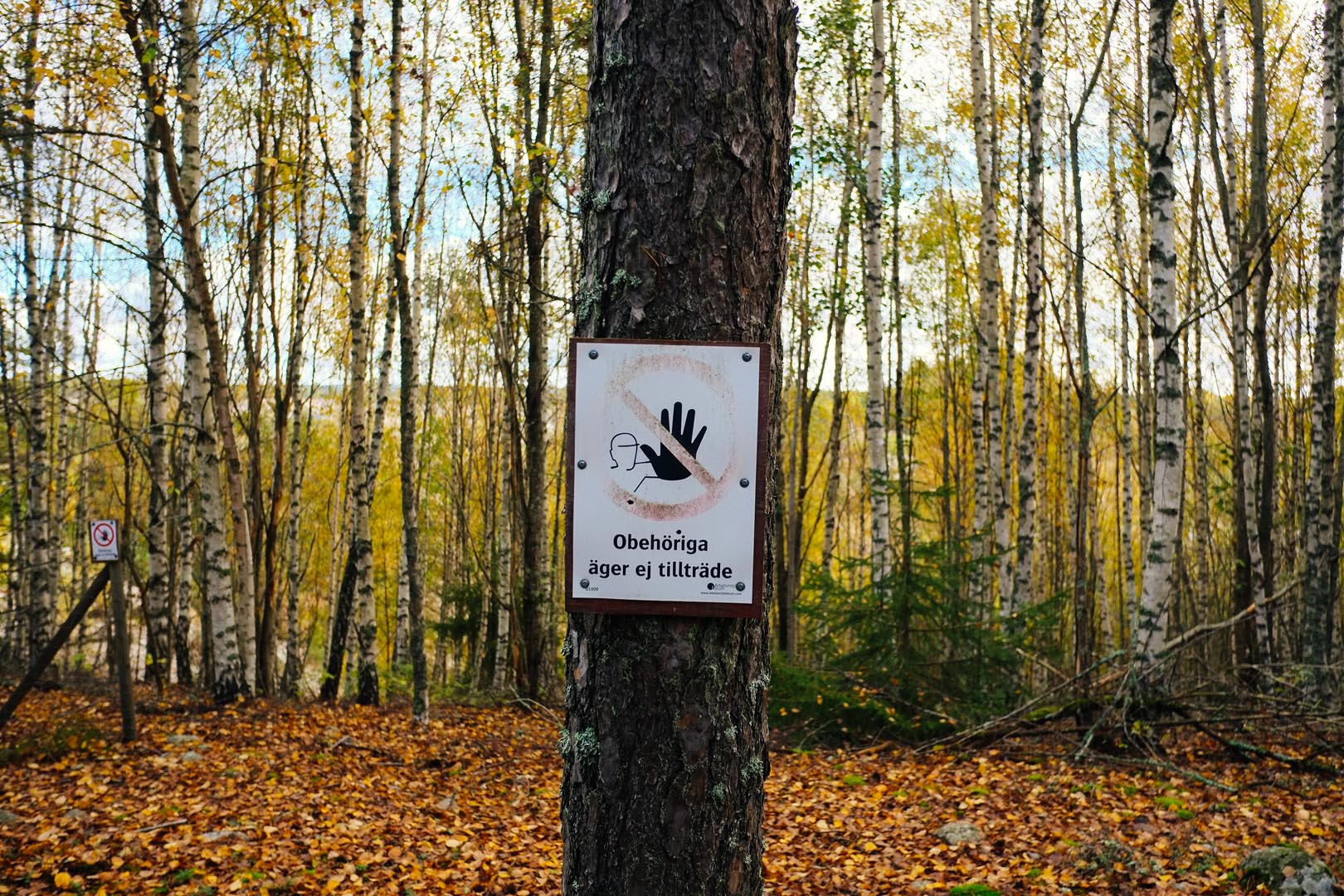
I scurry along through a low sandy ridge running along the quarry’s western edge. The wasteland stretches out below, abruptly transitioning from a desolate valley of small shrubs into a violent landscape of upturned earth. The trees are small, but thick and wild, offering at least a sense of cover from the menacing threat from above. Reaching into my jacket, I take out my phone and instinctively check my location on the map, reassured by the knowledge of my body’s exact geographic coordinates in this unfamiliar terrain. Shit! What if they are also tracking the GPS signals emitting from my pocket? In a hastened panic I turn it off, before making an ungraceful descent down the steep sandy embankment of the ridge—overwhelming my Blundstone boots in a torrent of sand and gravel. Scrambling for protection, I run towards a grove of pines, past a battered white sign nailed to a tree. The ominous red circle had long faded into a faint pink stain, but the open palm gesture and bold black text are still undeniably legible: OBEHÖRIGA ÄGER EJ TILLTRÄDE—an overcomplicated Swedish way of saying KEEP OUT.
The drone is back. I press my body tightly against the trunk of a nearby tree as the machine makes another pass above my head. Am I paranoid, or do I have legitimate reasons to be concerned? Have I been spotted, reported, registered? Are my movements monitored by some distant offsite security company— tracked on a screen in a windowless room somewhere by a burly man with a badge and a joystick? How were they onto me so fast? I had barely entered the zone before I encountered the drone. Did I trigger an alarm when I left the main road and entered the forest track behind the quarry, or was I dobbed in by one of the few residents of the secluded cottages scattered in the woods? My presence registering a threat to the otherwise tranquil surroundings.
Shaken by the encounter with the drone, I decide to abide by the sign’s command for the time being. Carefully, I proceed north, following the boundary fence, which at one point comes perilously close to tumbling into the pit below. The drone continues on its controlled circuit over the quarry, seemingly unconcerned with my presence. If I was viewed as a security threat, they would have sent someone by now. A white station wagon flaunting the sober corporate logo of a private security firm waiting to pick me up beyond the bend. What’s my alibi? What should I say if I’m stopped and questioned? Maybe I’m just out in the forest picking mushrooms—although it would be more believable if I had a basket with me. What about birdwatching? My knowledge of ornithology is rudimentary, but it would go some way in explaining the camera hanging over my shoulders. They would probably search me too. Hunt through my backpack looking for stolen goods—top-rate fine-grain glacial deposits which I would sell from the carpark at undercut prices.
Suddenly, the absurd notion of stealing small amounts of sand from a quarry brought me back to my senses, and my anxiety over the hovering drone quickly subsided. The market rate for sand is around forty euro a ton, yet the maximum quantity I could possibly haul off in my backpack would at most amount to a couple of kilograms. Not exactly a lucrative smuggling operation. No, the drone wasn’t part of some advanced security system—the multinational mining company has no need for such unnecessary expenses. In fact, at such bargain warehouse prices, one might wonder if it was in fact the mining company that was running the smuggling business. An organized cartel operating in broad daylight. Transforming cheap nature into fast cash, leaving nothing behind but a wasted hole and a million invisible carbon-dioxide particles to haunt us for generations to come.