Hamra Beach
In Urban Sprout, eds., Susanna Falck and Ebba Lövehed. Alta Art Space, 2023.
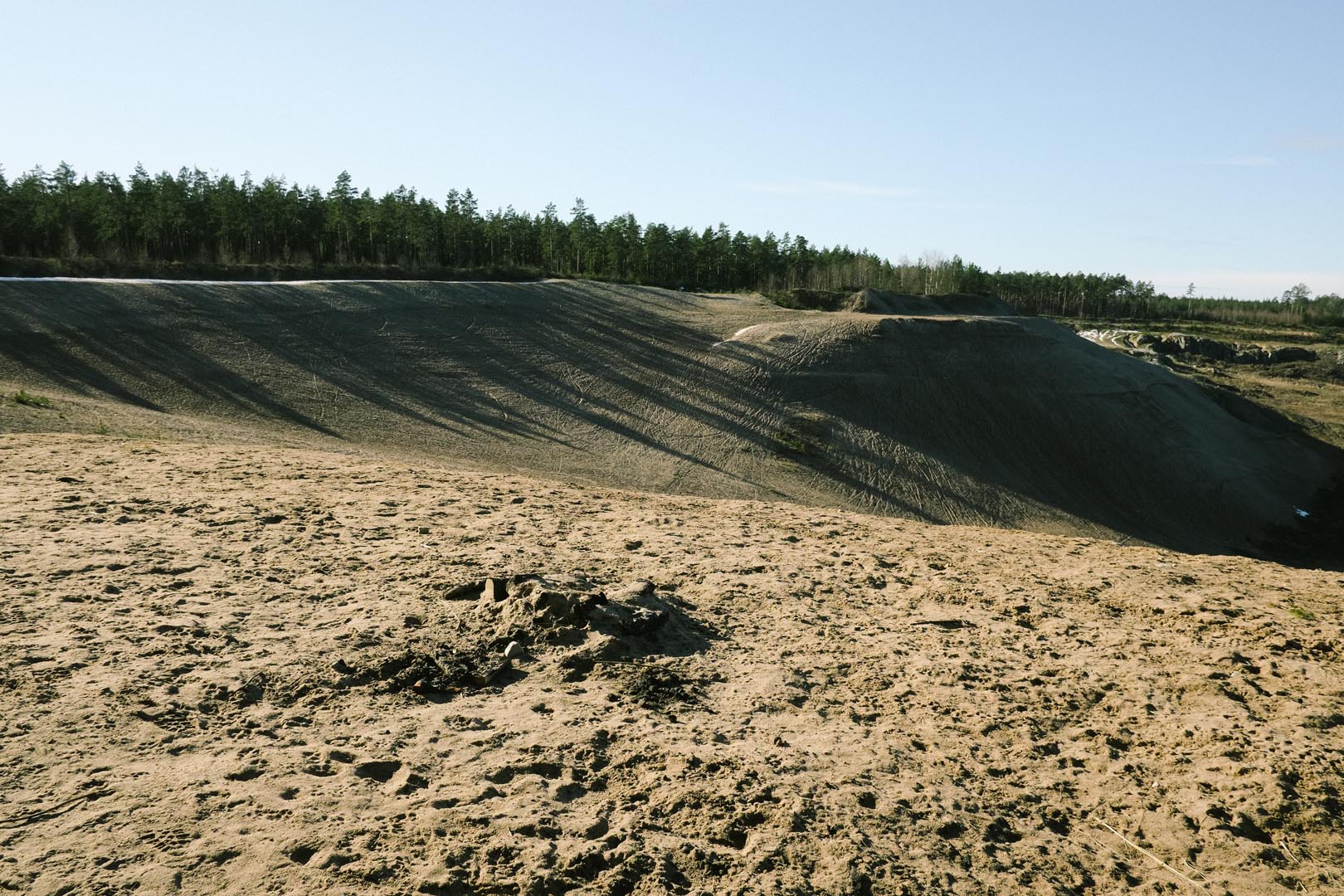
The glaring light of the low February sun momentarily blinds me, as I stumble out of the grove of scraggy pines, clinging perilously to the steep sandy slope. The dazzling rays a shock to the system after the long months of darkness. I take a moment to absorb the warm glow, radiating across my face—the only part of my body exposed to the frigid Stockholm air. An icy gust from the north reminds me that spring is still some months away. Most of the snow is now gone, decimated by the unusually mild weather, but a brave last stand has rallied in the shadows. A thin white crescent clearly marking the edge of this eerie landscape.
A fluorescent clad jogger runs past, her sneakers emitting a dampened thud as they struggle to find traction in the soft ground. The repetitive beat of her stride ripples across the landscape—a fitting ambient score to accompany the cinematic view before me. The only other people around are a pair of dog walkers on the far side of the bay, appearing to share a few polite words as their paths cross. Pleasantries about the weather. Dog related small talk. Their conversation inaudible, but soon cut short by the agitated yapping of the small terrier, obviously feeling no obligation to extend bourgeois decorum to the stoic golden retriever. Its owner tightens the leash, neutralising the confrontation, and they both resume their original trajectories once more.
“Sous les pavés, la plage!”[1] I’m, reminded of this famous slogan graffitied on the walls of Paris during the May 1968 protest movement, as I plod through the soft, dimpled earth. “Under the pavement the beach,” or alternatively translated as “the beach beneath the street.”[2] I continue down the gentle decline of shimmering sand, draped across the landscape like a crinkled bedsheet. Criss-crossed by dirt bike trails and the imprints of a thousand footprints. The sun is warm, and the air is fresh. I look towards the horizon, half expecting to see an endless expanse of blue. Gentle foamy waves lapping against the sandy shore. The picture before me, however, is quite different. The beach is real, yet it doesn’t elegantly fade into a glistening body of water, but instead tumbles haphazardly into a muddy wasteland of upturned earth and frozen puddles. A beach without a sea.
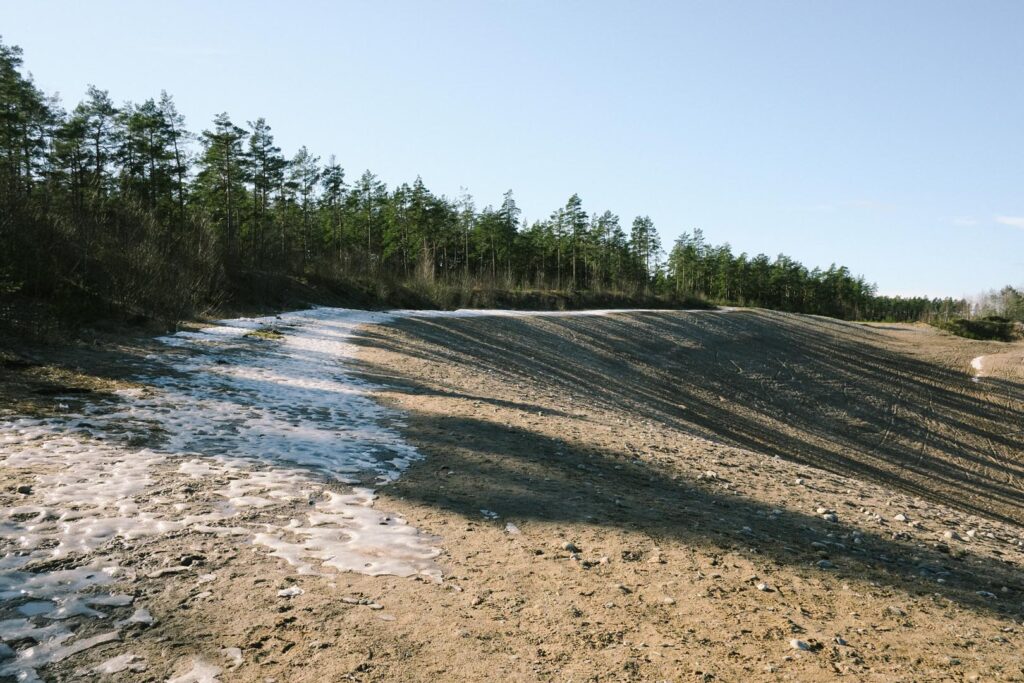
The beach beneath the street is both real and metaphorical. The beach is the revolutionary horizon emerging from the cracks of the present, the possibility of imagining another world, another life, an alternative future.[3] Yet the beach can also be understood more literally, as the layer of fine granular material squeezed between the granite cobblestones of the street surface, and the heavier roadbase below. The beach as a thin expanse of sand used to fix the pavers in place, while providing adequate drainage so that the street doesn’t become water-clogged during wet weather. The beach is a building material, a commodity, a product. Matter extracted, sorted, cleaned, packaged, sold, and transported to be put to use elsewhere.
I pass by the remains of a nocturnal gathering, the charred debris of a campfire etched into the earth like a bomb blast. Beer cans and cigarette packets strewn around like shrapnel. The scent of teenage rebellion lingering above the shifting dunes. I perceive that I too have entered a transitional state—a liminal landscape. Hamra beach, although lacking an adjoining body of water, nevertheless occupies an intertidal zone between different worlds—between the surface and the underground, public and private, legal and illegal, urban and rural, useful and useless. Situated on the periphery of Stockholm in the outer municipality of Botkyrka, the beach borders an elongated valley between low-rise suburbia and the green expanses of the Södertörn forest. A manufactured ravine caused by over one hundred years of extraction and exploitation.
Hamra, in Old Norse, roughly translates as ‘stony ground,’[4] probably referring to the large concentrations of gravel, pebbles, cobbles and boulders scattered across the landscape. Made smooth by the combined forces of wind, water and ice, these geologic drifters are what remain of an ancient river that gushed beneath the Fennoscandian icesheet, once covering much of northern Europe. Today, this fossilised riverbed forms a ribbon-like ridge which stretches over two-hundred kilometres, from Södertörn south of Stockholm, to the Gulf of Bothnia in the north.[5] In 1894 the renowned Swedish engineer, inventor, and business tycoon, Gustav de Laval, bought the Hamra estate, through his company Separator AB, which in 1901 opened a foundry producing the recently patented centrifugal milk separator, and other agricultural machinery.[6] Production demanded raw materials, especially casting sand, which was used to make the moulds in which the metal was cast. The slow displacement of the sands of Hamra thus began.
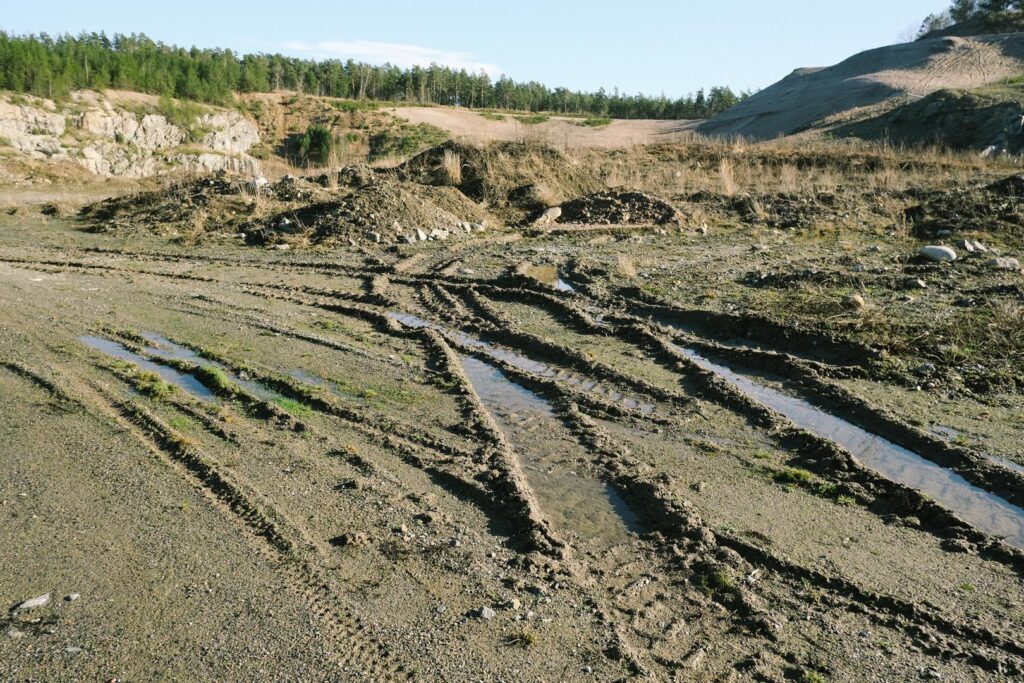
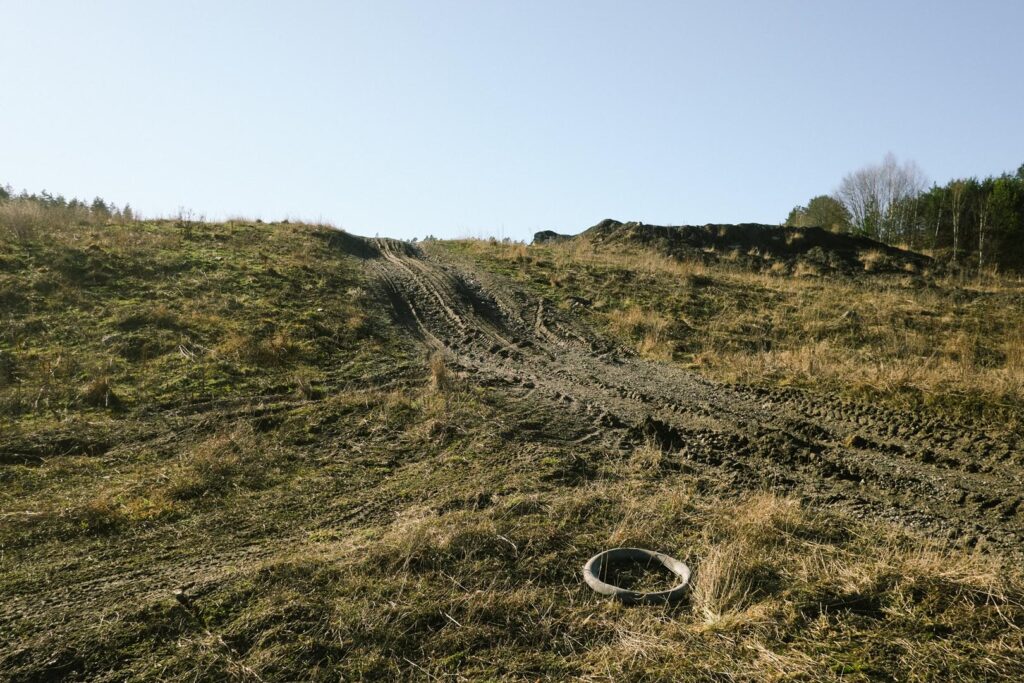
Below the dunes, the hue of the earth shifts from a golden caramel to a coffee-brown sludge, as I carefully weave between a perforated landscape of thawing ponds and mushy gouges carved by tyre treads. The mud is fresh, recently dumped here by the quarry operator as part of a remediation requirement. They had of course hoped to continue extracting material for many years to come, but the lease expired, and wasn’t renewed after reports revealed the groundwater table was alarmingly close to the surface. [7] As the groundwater here is interconnected to the catchment supplying Stockholm with drinking water, the risk of breach and contamination had to be taking seriously. Everything is connected.
Tap, tap, tap, tap, tap. A sharp hammering sound pierces the cold air, echoing around the granite walls enclosing the western edge of the quarry. Intrigued, I climb over a small rise to glimpse the source. There, hanging by a thread, a lone figure dangles perilously above a frozen pond. Ice-axes in each hand, furiously fighting against the forces of gravity and exhaustion. Will he make the ascent, or will he plunge into the dark pool below? A beautiful, yet seemingly impossible endeavour—yet the beach beneath the streets reminds us that it’s worth fighting for impossible dreams.
Notes:
[1] The slogan is credited with being coined by student activist Bernard Cousin in collaboration with public relations expert Bernard Fritsch. Anne Vidalie, “Sous les pavés, les slogans,” L’Express, 30 April 2014, http://www.lexpress.fr/actualite/politique/sous-les-paves-les-slogans_458376.html.
[2] McKenzie Wark, The Beach beneath the Street: The Everyday Life and Glorious Times of the Situationist International (London: Verso, 2011).
[3] Guy Debord, “Théorie de la dérive,” in Internationale Situationniste #2, December 1958, republished in Situationist International Anthology, ed. Ken Knabb, (Berkeley, CA: Bureau of Public Secrets, 2006).
[4] According to the Nordic cooperative committee for onomastic research http://www.norna.org/sites/default/files/nonelex/-hammar(e).pdf
[5] This ridge is known as Uppsalaåsen, and is an esker formed towards the end of the last ice age, as the Fennoscandian ice sheet began to retreat. The southern section of the ridge is often referred to as Tullingeåsen.
[6] https://docplayer.se/19578911-Vita-villorna-100-ar-1.html
[7] https://www.mitti.se/nyheter/grustag-stangs-av-miljoskal/lmmbl!167138/